
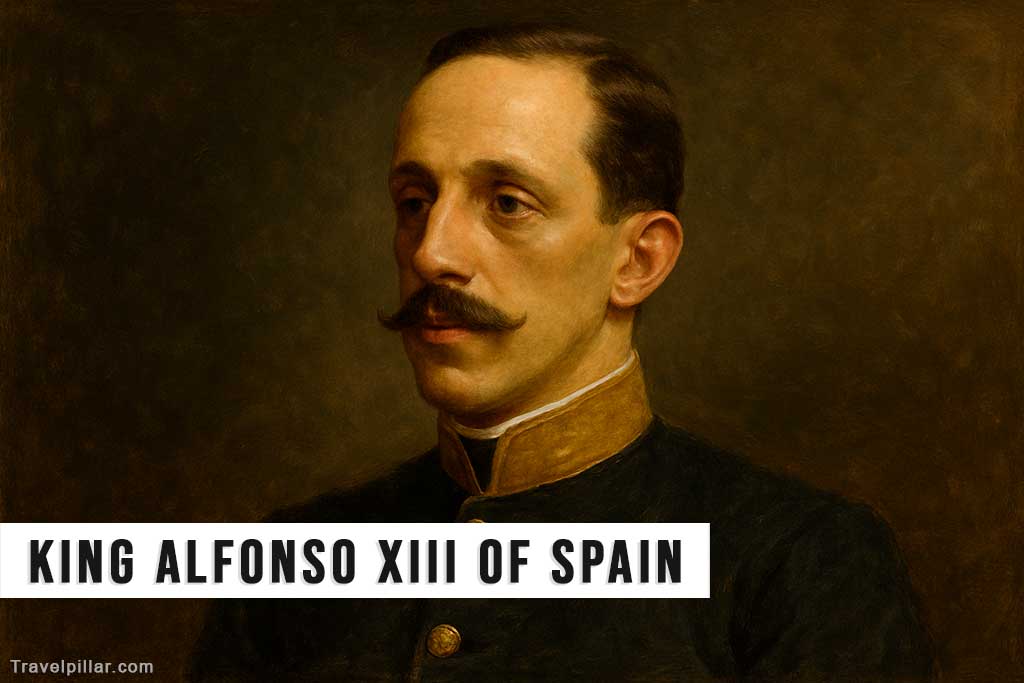
King Alfonso XIII (1886–1941) was the last king of Spain before the country briefly transitioned into a republic. He reigned from birth, as his father, King Alfonso XII, died before he was born, making him king the moment he entered the world in 1886. His reign was marked by political instability, economic challenges, and social unrest, which reflected Spain’s complex situation in the early 20th century.
Alfonso XIII assumed direct rule upon reaching maturity in 1902, during a period when Spain was grappling with the loss of its last colonies—Cuba, Puerto Rico, and the Philippines—after the Spanish-American War. The early years of his rule were characterized by attempts to modernize Spain and navigate through political divisions between conservatives, liberals, republicans, and growing labor movements. Despite efforts to promote tourism and industry, his reign was overshadowed by frequent government changes, corruption, and increasing social tensions.
One of the most significant challenges of his rule was Spain’s involvement in the Rif War in Morocco (1909–1927). The conflict was costly and unpopular, leading to unrest and dissatisfaction among the Spanish populace. The disastrous Battle of Annual in 1921, which resulted in a severe military defeat, further destabilized his reign.
In 1923, seeking to restore order, Alfonso supported a military coup led by General Miguel Primo de Rivera, who established a dictatorship. Although initially stabilizing, this regime eventually lost support, and Primo de Rivera resigned in 1930. The political vacuum that followed led to widespread calls for republicanism.
Faced with growing opposition, Alfonso XIII left Spain in 1931 following municipal elections that overwhelmingly favored republican candidates. His departure marked the end of the Spanish monarchy until its restoration in 1975. Alfonso spent his remaining years in exile and died in Rome in 1941.
Visitors to Spain can explore sites connected to Alfonso XIII’s reign, such as the Royal Palace of Madrid and the luxurious Hotel Alfonso XIII in Seville, built to commemorate the 1929 Ibero-American Exposition, reflecting the cultural ambitions of his era.