
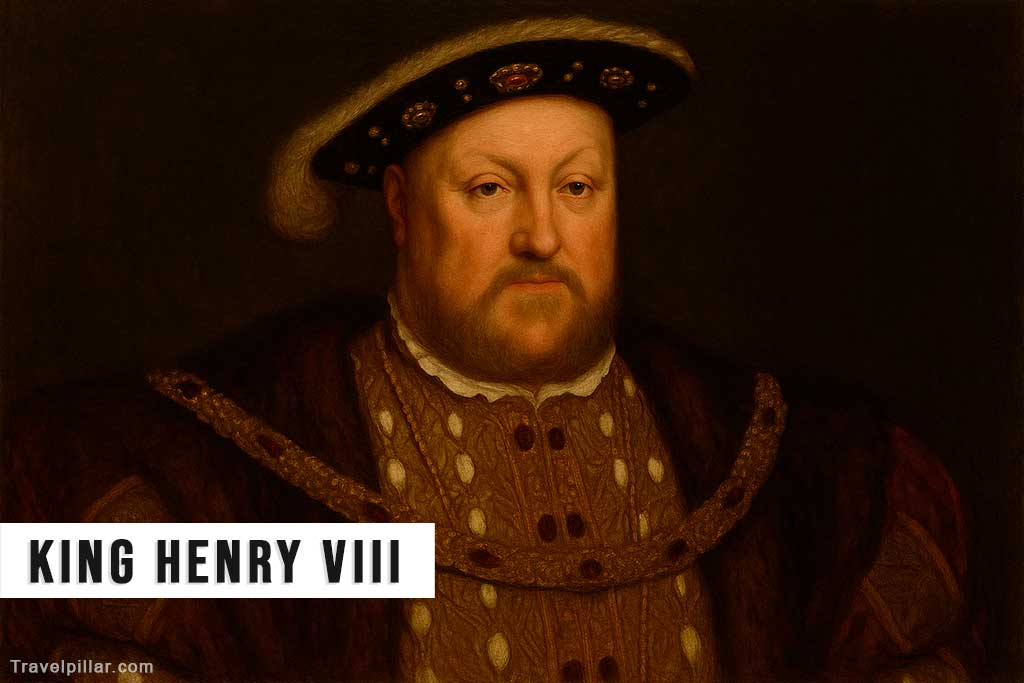
King Henry VIII (1491–1547) was one of England‘s most influential and controversial monarchs. Reigning from 1509 until his death in 1547, he is best known for his role in the English Reformation, which led to the establishment of the Church of England and the nation’s break from the Catholic Church.
Henry VIII was the second Tudor monarch, succeeding his father, Henry VII. His early reign was marked by a strong relationship with the Catholic Church and a marriage to Catherine of Aragon, which produced no male heir. This lack of a male successor led Henry to seek an annulment from Catherine, a request the Pope denied. Frustrated by the refusal, Henry initiated the English Reformation, ultimately declaring himself the Supreme Head of the Church of England in 1534. This move allowed him to annul his marriage and marry Anne Boleyn.
Throughout his life, Henry VIII married six times in pursuit of a male heir and political alliances. His marriages, which included two annulments, two executions, and a divorce, had significant impacts on English society and politics. The dissolution of monasteries, a direct result of the break with Rome, led to the redistribution of church lands and wealth, altering the religious and economic landscape of England.
Henry VIII was also known for his contributions to the navy, expanding and modernizing it, which laid the groundwork for England’s later dominance as a maritime power. His reign saw the construction of several important fortifications along the English coastline, reflecting his concern for national defense.
Today, visitors to England can explore numerous sites associated with Henry VIII, including Hampton Court Palace, his former residence, and the Tower of London, where two of his wives, Anne Boleyn and Catherine Howard, were executed. The ruins of monasteries across the country also serve as reminders of the sweeping changes during his rule. Henry VIII’s legacy remains a complex mix of religious transformation, political power, and cultural impact that shaped the future of England.