
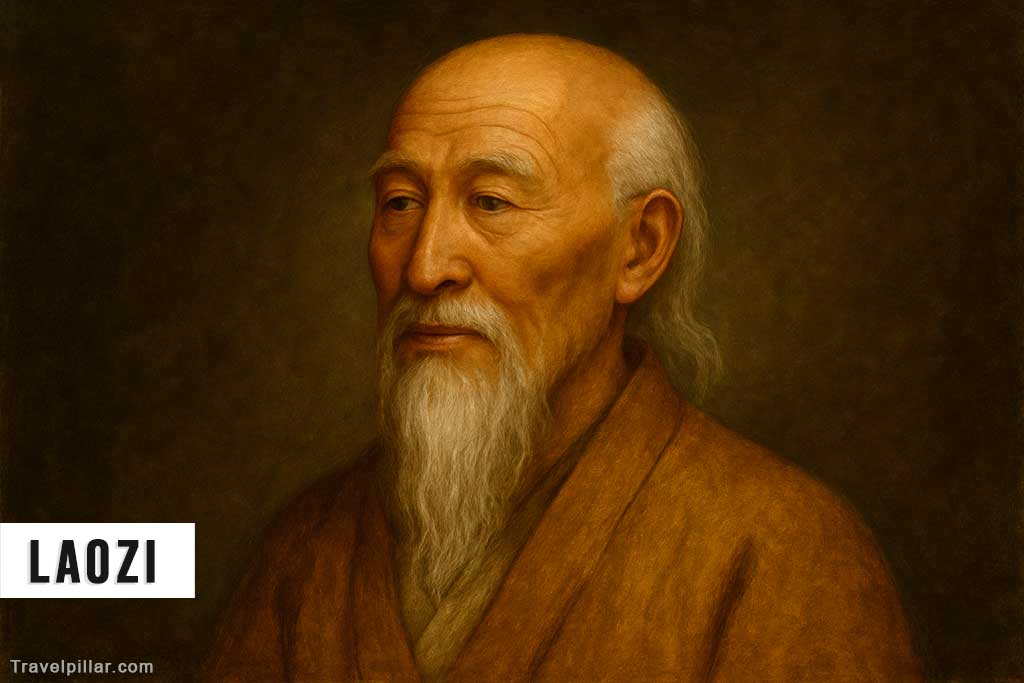
Laozi, also spelled Lao Tzu, is a central figure in Chinese philosophy and is traditionally regarded as the founder of Daoism (Taoism). Although the historical existence of Laozi is debated, he is generally thought to have lived in the 6th century BCE, during the Eastern Zhou dynasty. His teachings are preserved in the Dao De Jing (Tao Te Ching), a foundational text of Daoist philosophy, which has been influential in both religious and philosophical contexts throughout East Asia and beyond.
According to tradition, Laozi served as an archivist in the Zhou imperial court before withdrawing from public life. The story holds that he composed the Dao De Jing at the request of a border guard before departing into the western regions, after which he was never seen again. Whether Laozi was a historical figure or a legendary one remains uncertain, and some scholars consider the Dao De Jing to be the work of multiple authors compiled over time.
The central concept in Laozi’s philosophy is the Dao (or Tao), often translated as “the Way.” The Dao is understood as the underlying, ineffable force that gives rise to all things and governs the natural order. It is not a deity but an abstract principle of harmony, spontaneity, and balance. Laozi advocates aligning with the Dao through the practice of wu wei, often translated as “non-action” or “effortless action.” This does not imply passivity, but rather acting in accordance with the natural flow of events, without force or contrivance.
Laozi’s teachings emphasize simplicity, humility, and the limitation of desire. He viewed social institutions, rigid laws, and excessive ambition as distortions of the natural order. In contrast, he advocated for a return to a more organic and unstructured way of life, where harmony could be maintained by minimizing interference and allowing things to develop naturally. In political thought, he supported minimal governance, arguing that rulers should lead by example and not by coercion.
The influence of Laozi extends beyond Daoism into Confucianism, Buddhism, and various schools of Chinese thought. His ideas have also had resonance in modern discussions on ecology, leadership, and ethics. The Dao De Jing remains one of the most translated and studied philosophical texts in the world, continuing to attract interest for its concise, aphoristic style and its emphasis on balance, paradox, and the limits of human knowledge.