
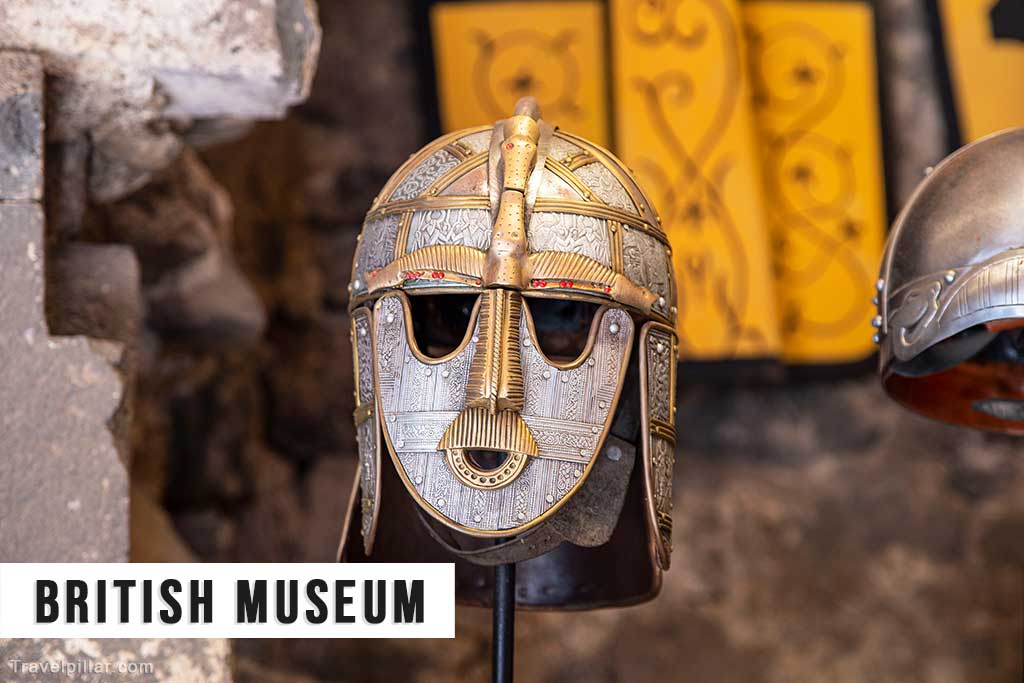
The Sutton Hoo Treasure, one of the British Museum’s most celebrated collections, was discovered in 1939 at an Anglo-Saxon burial site in Suffolk, England. This remarkable find dates to the early 7th century and is associated with the East Anglian elite, possibly King Rædwald. The treasure is from a ship burial, a practice reflecting significant Scandinavian influence, wherein a ship was used as a burial chamber for a high-ranking individual, surrounded by grave goods symbolizing wealth and power.
The centerpiece of the collection is the iconic Sutton Hoo helmet, an intricately decorated piece of ceremonial armor featuring complex designs of warriors, animals, and mythological scenes. Other notable items include a shield, a pattern-welded sword, gold belt buckles, shoulder clasps adorned with garnets and intricate filigree, and a purse lid displaying remarkable cloisonné craftsmanship. These artifacts exemplify the artistic sophistication and technical skill of Anglo-Saxon artisans.
The treasure also includes coins, silverware, and imported objects, such as Byzantine bowls, that reflect the far-reaching trade connections of early medieval England. These items provide evidence of the cultural and economic exchanges between Britain and continental Europe during this period.
The discovery of the Sutton Hoo Treasure has significantly advanced the understanding of Anglo-Saxon England’s social structure, burial practices, and craftsmanship. It has reshaped perceptions of the so-called “Dark Ages,” revealing a society capable of producing art of extraordinary beauty and complexity.
Today, the Sutton Hoo artifacts are displayed prominently in the British Museum, where they are studied for their historical and cultural significance. The site itself is preserved as an archaeological landmark managed by the National Trust, further emphasizing its importance.
The Sutton Hoo Treasure remains a key resource for historians and archaeologists, offering profound insights into the art, power, and identity of early medieval England. Its discovery stands as one of Britain’s most important archaeological achievements.