
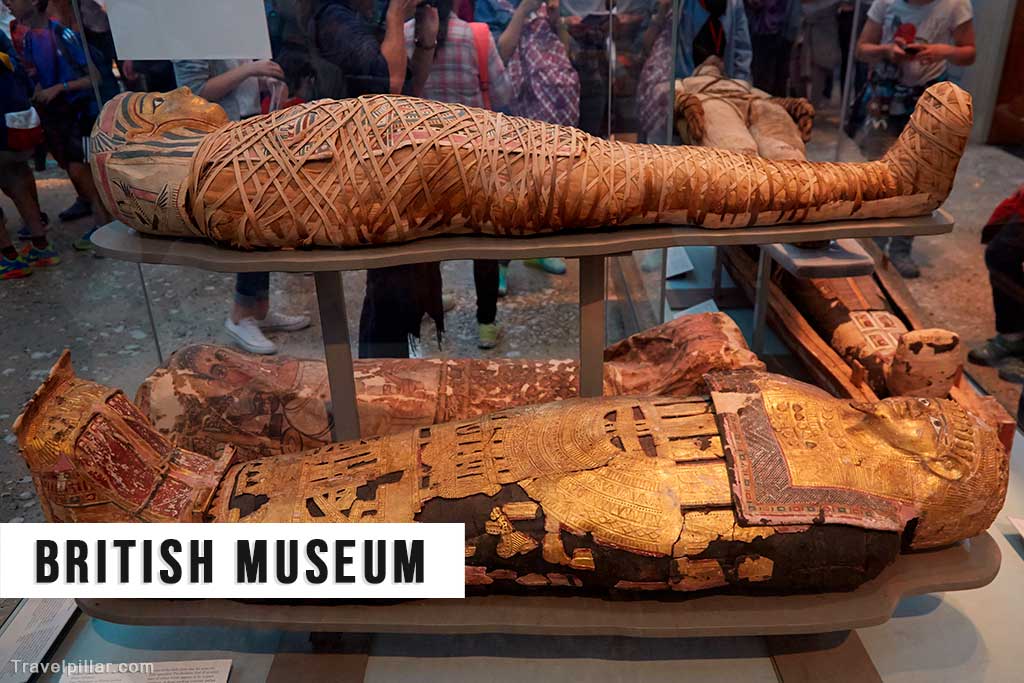
The collection of Egyptian mummies in the British Museum is one of the most extensive and significant in the world, providing valuable insights into ancient Egyptian beliefs, practices, and society. These mummies, preserved through a complex embalming process, span thousands of years, from the Old Kingdom to the Roman Period. They exemplify the ancient Egyptians’ intricate funerary traditions and their deeply held beliefs about the afterlife.
The mummies represent individuals from various social strata, from high-ranking officials and priests to ordinary citizens. Many are displayed in their original coffins, often elaborately decorated with hieroglyphic inscriptions and vivid depictions of deities, designed to guide the deceased through the afterlife. Notable examples include the mummies of the priestess Henutmehyt and the young boy known as “Gebelein Man,” whose natural preservation predates the era of artificial mummification.
The museum’s collection also includes an array of funerary artifacts such as canopic jars, shabti figurines, and amulets. These objects were placed in tombs to protect and assist the deceased in the afterlife. Canopic jars, for example, were used to store the mummified internal organs, while shabti figurines were believed to perform labor on behalf of the deceased.
Scientific research on the mummies has advanced the understanding of ancient Egyptian health, diet, and society. Modern imaging techniques like CT scans and X-rays have revealed detailed information about their physical condition, age at death, and the diseases they may have suffered. For example, studies have identified evidence of dental abscesses, arthritis, and even heart disease in some mummies.
The mummies are displayed in the museum’s Egyptian galleries, alongside explanatory texts and exhibits detailing their cultural and historical context. The collection emphasizes not only the technical skill of ancient embalmers but also the enduring significance of death and the afterlife in Egyptian culture. By preserving these mummies, the British Museum provides a window into a civilization that continues to captivate and inform contemporary audiences.
Highlights from the British Museum Mummies Collection
1. Gebelein Man
A naturally mummified body from around 3400 BCE, found in Gebelein, Egypt. It is one of the oldest preserved bodies, showing burial practices before artificial mummification.
2. Mummy of Katebet
A high-status woman from the 19th Dynasty (c. 1295–1186 BCE). Her coffin and wrappings are finely decorated, with a gilded mask and amulets for protection in the afterlife.
3. Mummy of Hornedjitef
A priest of Amun from Thebes, dating to the 3rd century BCE. His nested coffins are painted with texts and scenes to ensure safe passage through the underworld.
4. Mummy of Takhebkhenem
A woman from the Late Period (c. 664–332 BCE), displayed with CT scans and facial reconstruction to illustrate scientific study of mummified remains.
5. Mummy of a young man with portrait (Faiyum)
A Roman Period mummy (c. 100–200 CE) with a painted wooden portrait panel attached to the wrappings, reflecting Greco-Roman funerary practices in Egypt.
6. Mummy of a cat
Animal mummification was common in Egypt as offerings to deities. The museum displays several mummified cats, including one with linen wrappings in a geometric pattern.
7. Mummy of Nesperennub
A temple priest from around 800 BCE. His coffin remains unopened but has been digitally ‘unwrapped’ to reveal his preserved state and funerary items using CT scanning.
8. Mummy of Cleopatra
Not Cleopatra VII, but an adult female mummy named Cleopatra from Thebes, dating to the Roman Period, with cartonnage mask and gilded details.