
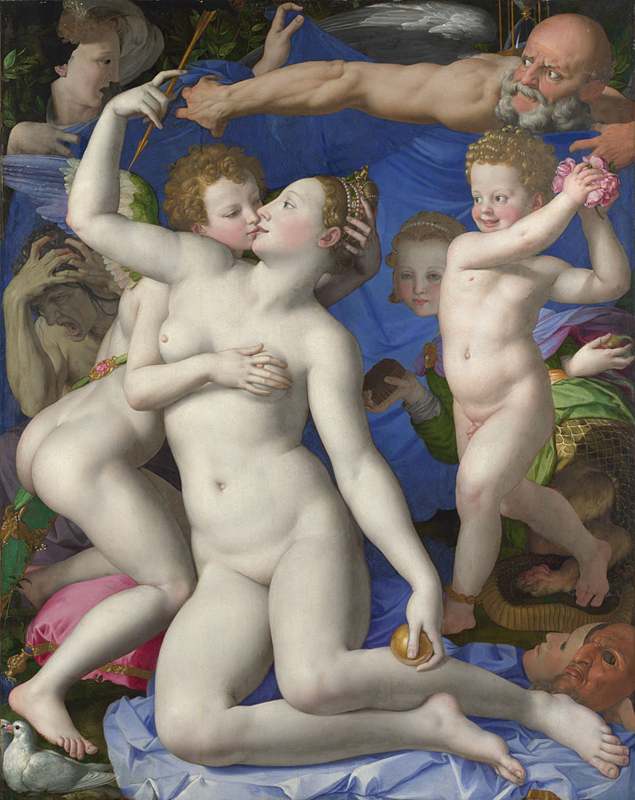
An Allegory with Venus and Cupid is a complex and intellectually layered painting by the Florentine artist Bronzino, created around 1545. It is now housed in the National Gallery, London. At first glance the scene appears decorative and elegant, but its meaning is deliberately unsettling. The painting was probably intended as a gift for the French court and functions as a moral warning disguised as a mythological tableau.
At the centre are Venus, the Roman goddess of love, and her son Cupid. In classical mythology, Cupid is often portrayed as a mischievous child whose arrows cause people to fall in love. Here, however, he embraces and kisses his mother in a deliberately ambiguous and provocative gesture. The intimacy is unnatural and was likely intended to symbolise the dangerous and irrational power of desire. Venus holds a golden apple, a reference to the Judgement of Paris, the myth in which she won a beauty contest among the goddesses and was awarded the apple of discord. That event ultimately led to the Trojan War, reminding viewers that desire and vanity can have catastrophic consequences.
Around them, the supporting figures deepen the allegory. A laughing boy scatters rose petals, traditionally associated with love, yet he stands on thorns, suggesting that pleasure is inseparable from pain. Behind Venus lurks a shadowy figure sometimes interpreted as Jealousy or Despair, twisting in silent agony. To the right, a creature with a beautiful face but a serpentine body and clawed hands represents Fraud or Deceit. She offers a honeycomb in one hand while hiding a stinger in the other, reinforcing the idea that sweetness conceals harm.
At the top of the painting, a bearded figure—often identified as Time—pulls back a blue drapery as if revealing the scene. Beside him is Oblivion or Forgetfulness, suggesting that truth is eventually exposed, even if people try to conceal it. The entire composition can be read as a warning about lust, vanity, and the fleeting nature of pleasure.
For modern viewers, the painting remains compelling because it operates like a visual puzzle. It rewards careful looking and invites interpretation, reminding us that Renaissance art was not only about beauty but also about moral reflection and intellectual challenge.
Weblink: https://www.nationalgallery.org.uk/