
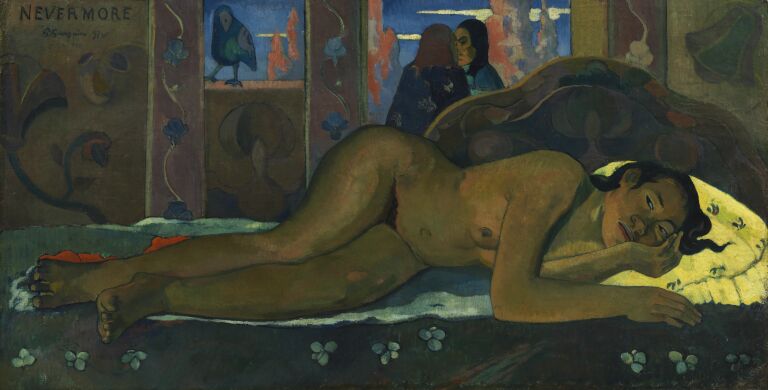
Displayed in the Courtauld Gallery in London, Nevermore by Paul Gauguin is one of the most mysterious and psychologically complex paintings in the museum’s collection. Painted in 1897 during Gauguin’s time in Tahiti, the work reflects the artist’s fascination with symbolism, mythology and non-European cultures. Created during the Post-Impressionist period, the painting combines personal emotion with dreamlike imagery in a way that helped shape the development of modern art.
The painting shows a young Tahitian woman lying on a bed while a dark raven perches nearby. Two shadowy figures appear in the background, adding to the unsettling atmosphere. The title Nevermore directly references Edgar Allan Poe’s famous poem The Raven, in which the repeated word symbolises grief, loss and psychological torment. Gauguin deliberately connected the painting to themes of death, memory and melancholy rather than simply portraying an exotic scene.
At first glance, the composition appears calm and intimate, yet the mood feels tense and ambiguous. The woman’s expression is difficult to interpret, and the dark bird creates an atmosphere of unease. Gauguin often used symbolism rather than realism, encouraging viewers to respond emotionally rather than searching for a straightforward narrative.
The painting was created during a difficult period in Gauguin’s life. By the late 1890s he was struggling financially, suffering from poor health and grieving the death of his daughter in France. These personal hardships influenced the darker emotional tone found in many of his later works. Although Gauguin travelled to Tahiti searching for what he imagined as a simpler and more “authentic” life, modern critics have increasingly questioned his romanticised view of Polynesian culture and aspects of his behaviour while living there.
Artistically, Nevermore helped push European painting away from traditional realism. Gauguin used flattened shapes, bold colour contrasts and simplified forms instead of naturalistic detail. This approach later influenced major modern artists including Picasso and Matisse.
Many people consider Nevermore one of Gauguin’s greatest paintings because it combines beauty with emotional uncertainty. The work resists simple interpretation and leaves viewers questioning what they are really seeing and feeling.
For visitors exploring the Courtauld Gallery in London, Nevermore offers a striking contrast to more traditional European paintings nearby. Its combination of symbolism, personal emotion and cultural tension makes it one of the gallery’s most thought-provoking works.
Weblink: https://gallerycollections.courtauld.ac.uk/object-p-1932-sc-163