
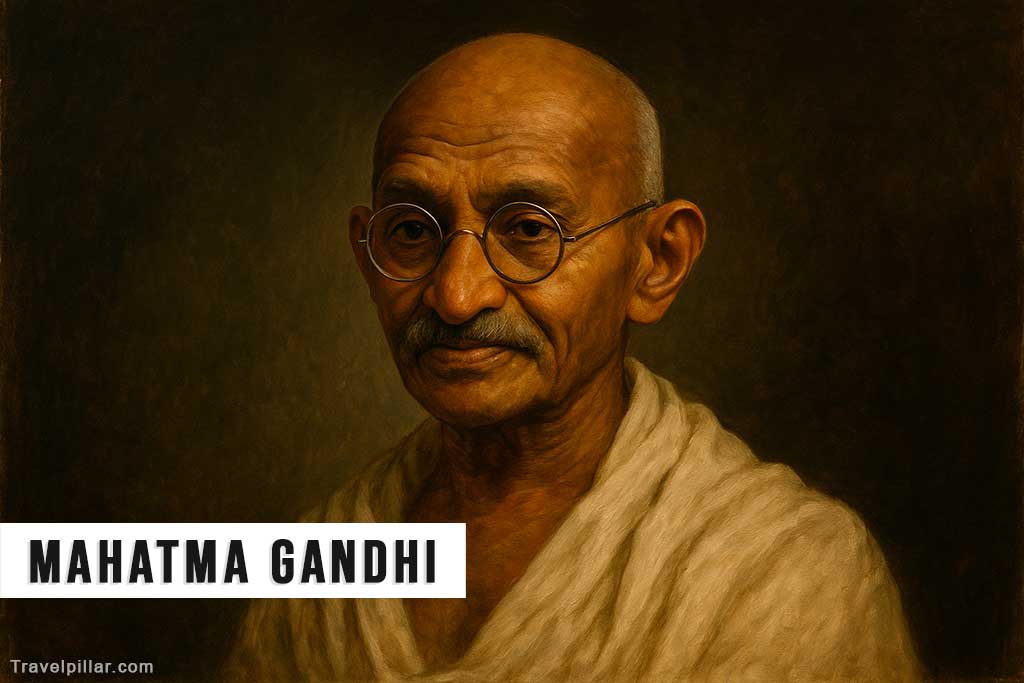
Mahatma Gandhi, born on October 2, 1869, in Porbandar, India, was a political and spiritual leader who championed nonviolent resistance in the struggle for Indian independence from British rule. His philosophy of nonviolence and civil disobedience influenced political movements worldwide, earning him the honorific “Mahatma,” meaning “great soul.”
Gandhi’s approach to political activism evolved during his time in South Africa, where he experienced racial discrimination and developed “Satyagraha” (devotion to truth), a form of nonviolent resistance to injustice. Returning to India in 1915, he became a leading figure in the Indian National Congress, advocating for Indian self-rule (Swaraj) and social reforms.
Among his most notable protests was the 1930 Salt March, a 240-mile march to the Arabian Sea to collect natural salt as a symbolic act of defiance against the British salt monopoly. The march, and the nonviolent protests that followed, drew international attention to the Indian independence movement.
During World War II, Gandhi led the “Quit India” movement, demanding an end to British rule. Despite several imprisonments, he remained a steadfast advocate of nonviolence and unity between Hindus and Muslims.
Gandhi was assassinated on January 30, 1948, by a Hindu nationalist, but his ideas and tactics lived on. His philosophy of peace and nonviolence influenced key figures such as Martin Luther King Jr. and Nelson Mandela and remains relevant in various social and political movements globally.
Gandhi’s commitment to nonviolence, religious tolerance, and social justice, coupled with his significant role in leading India to independence, has made him an enduring symbol of peaceful resistance. Despite controversies over aspects of his philosophy and personal life, his contribution to developing a nonviolent mode of political activism continues to be highly influential.