
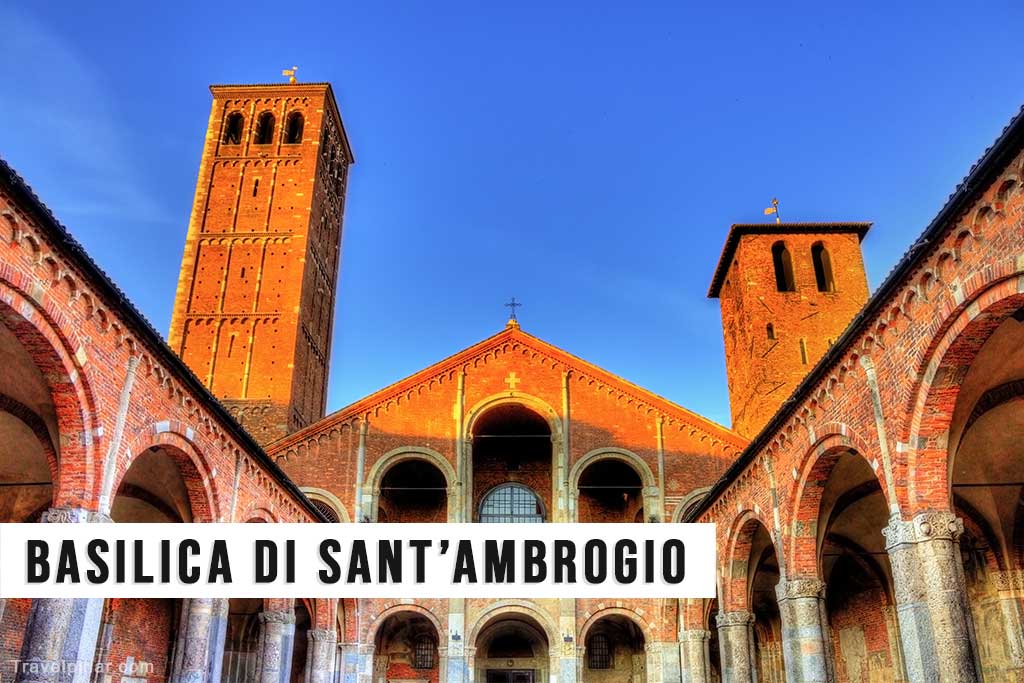
The Basilica di Sant’Ambrogio in Milan, Italy, is one of the most ancient churches in the city and a significant monument of Lombard Romanesque architecture. The church stands as a testament to Milan’s long and rich religious history, dating back to the 4th century, when it was originally built by Bishop Ambrose, later Saint Ambrose, the patron saint of Milan.
Over the centuries, the structure of the Basilica di Sant’Ambrogio underwent several modifications and reconstructions. The existing structure, built mainly in the 11th to the 12th century, showcases distinct features of Lombard Romanesque style. It includes a brick facade with two large bell towers of unequal height, known as the “Two Sisters” and the “Monk,” respectively.
The basilica features a unique atrium, a courtyard preceding the entrance, enclosed by colonnades on three sides. This atrium, a rare architectural feature in contemporary churches, harks back to early Christian architecture. The interior is characterized by its robust brick and stone construction, heavy arches, and a nave flanked by two aisles.
Significant artistic and religious artifacts embellish the interior. The church houses the golden “Altar of Saint Ambrose,” a masterpiece of Carolingian goldwork, and the sarcophagus of Stilicho, a high-ranking general in the Roman army, noted for its intricate bas-relief decoration. Additionally, the crypt beneath the high altar holds the relics of Saint Ambrose and other martyrs.
The Basilica di Sant’Ambrogio has witnessed many significant historical events. It is the site where Emperor Louis the Pious was crowned by Pope Stephen IV in 816 and where, in 386, Saint Ambrose famously denied Emperor Theodosius I access, leading to his penance.
Official website: https://www.basilicasantambrogio.it (Italian)
Google map 4.7/5