
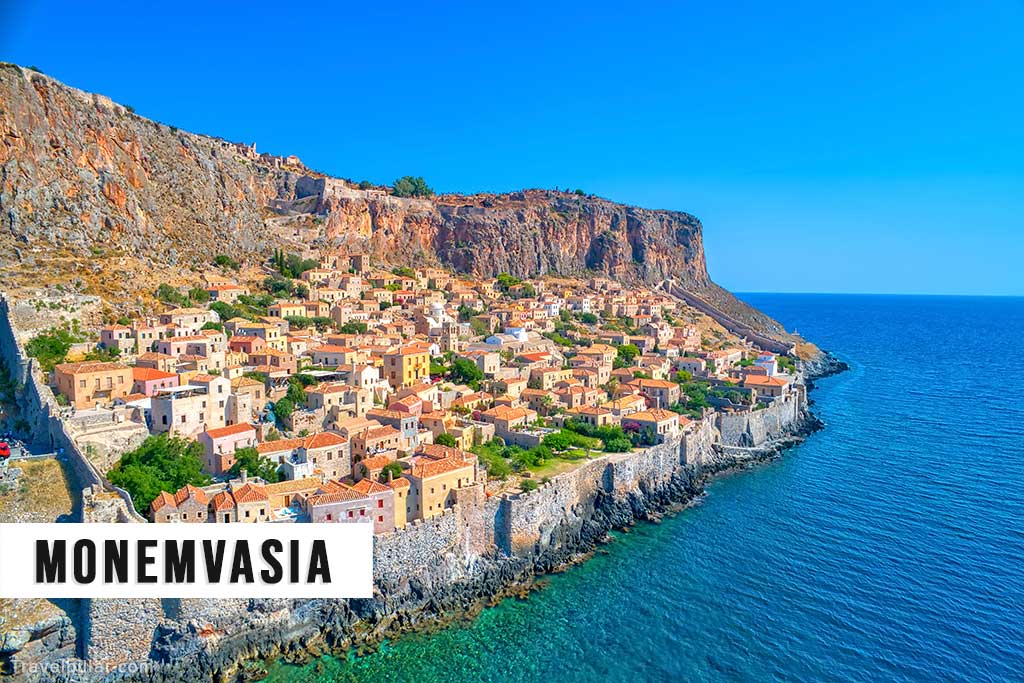
Monemvasia is a fortified medieval town located on a small rocky island off the southeastern coast of the Peloponnese, connected to the mainland by a narrow causeway. The island is approximately 300 metres wide and 1 kilometre long, rising steeply from the sea and offering a naturally defensible position. The name Monemvasia means “single entrance,” referring to the sole access point into the town through a fortified gate.
The town was founded in the 6th century CE during a period of population movements caused by Slavic invasions. It developed into a significant commercial and military centre during the Byzantine period and later came under the control of the Venetians and Ottomans. Its strategic location made it an important port and defensive outpost for successive powers.
Monemvasia is divided into two distinct sections: the Lower Town and the Upper Town. The Lower Town, which is still inhabited, consists of narrow stone-paved streets, houses built in traditional Byzantine and Venetian styles, and several churches, including the well-preserved Church of Elkomenos Christos. The Upper Town, situated on the plateau above, is mostly in ruins but contains the remains of churches, cisterns, and fortifications. The Church of Hagia Sophia, built in the 12th century, is one of the few structures still standing and offers views across the Laconian Gulf.
The town is accessible only on foot, with no motor vehicles permitted inside the walls. Restoration efforts have preserved much of its original character, and tourism is now a key part of the local economy.
Monemvasia is of interest due to its preserved medieval urban fabric, strategic geography, and continuous historical occupation. It is considered one of the best examples of a Byzantine fortified town in Greece, offering insight into medieval life in the Peloponnese.