
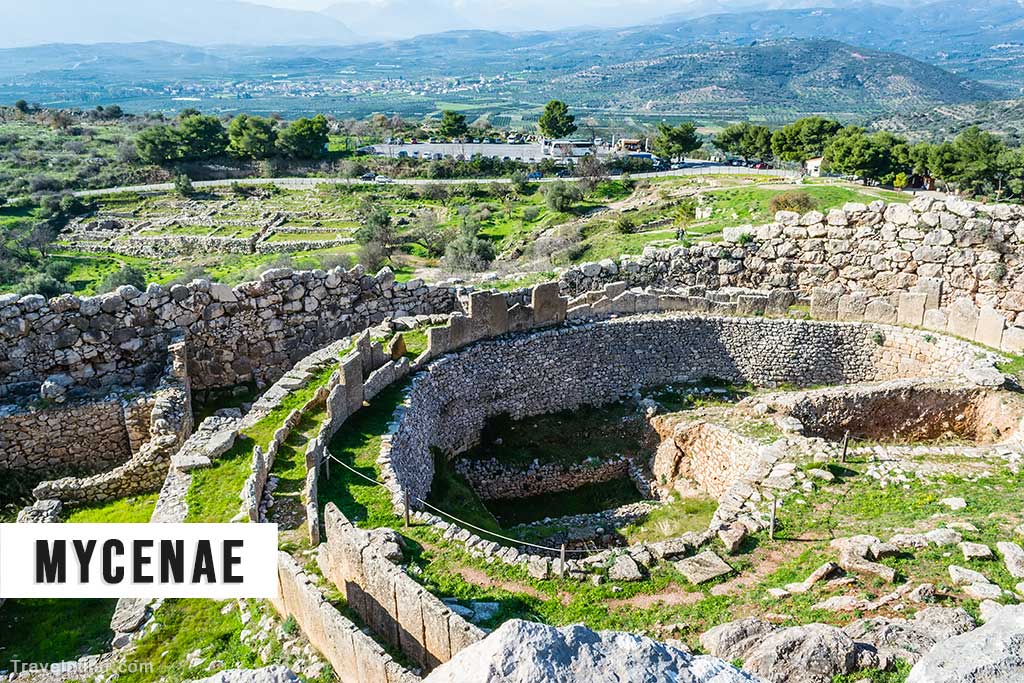
Mycenae is an important archaeological site located in the northeastern Peloponnese. It was one of the major centres of Greek civilization during the Late Bronze Age and gave its name to the Mycenaean civilization, which dominated much of southern Greece from approximately 1600 to 1100 BCE.
The site is best known for its monumental architecture, including the fortified acropolis and its distinctive cyclopean walls, constructed with large, roughly-hewn limestone boulders. Entry to the citadel is through the well-preserved Lion Gate, named after the relief sculpture of two lions that stands above the entrance. Inside the walls are the remains of royal residences, storage rooms, workshops, and a complex water system.
One of the key features of Mycenae is the Grave Circle A, where shaft graves containing gold funeral masks, weapons, and jewellery were discovered. These graves date to the 16th century BCE and are thought to belong to Mycenaean elite. Outside the citadel lies Grave Circle B, as well as several tholos tombs, or beehive tombs, including the so-called Treasury of Atreus and the Tomb of Clytemnestra, notable for their large corbelled domes and monumental entrances.
The Mycenaeans played a significant role in early Greek culture, and Mycenae itself is linked in later tradition with the Homeric epics, particularly through the figure of King Agamemnon. While the historical accuracy of these legends is debated, the archaeological evidence points to a highly developed society with extensive trade networks and administrative organisation.
The site is accompanied by a museum that displays artefacts found during excavations, including pottery, weapons, and burial goods. Mycenae provides valuable insight into the structure and sophistication of prehistoric Greek civilisation and remains a central reference point for understanding the origins of classical Greek culture.
Google map 4.7/5