
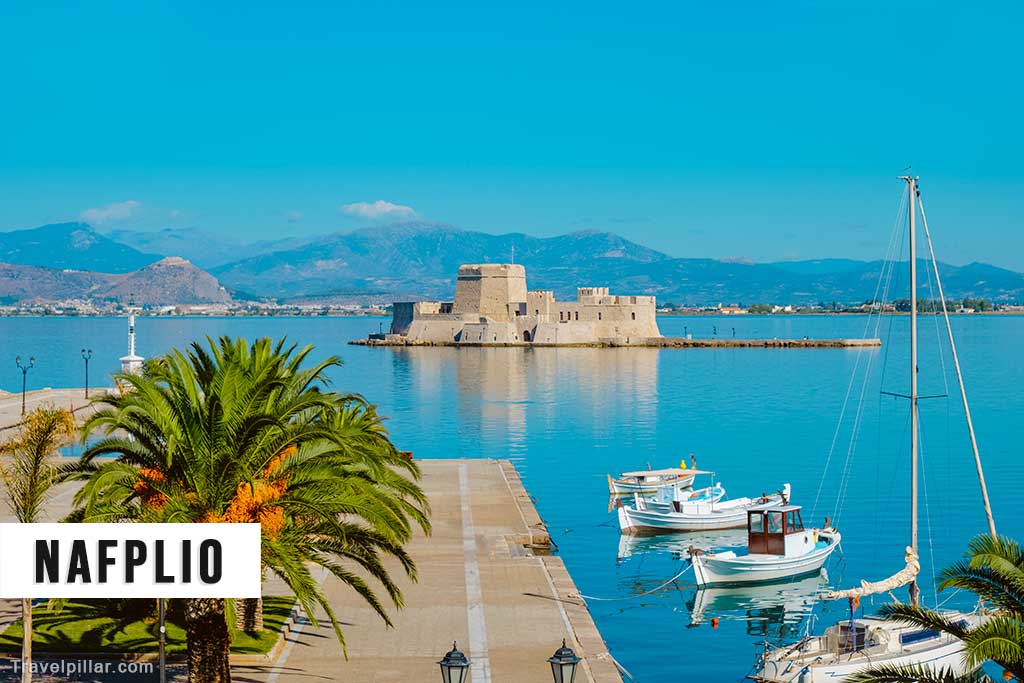
Nafplio is a seaport town in the northeastern Peloponnese, located on the Argolic Gulf in Greece. It has played a significant role in Greek history due to its strategic coastal position and has been continuously inhabited since antiquity. The town is notable for its blend of medieval, Venetian, and neoclassical architecture, reflecting its complex history of occupation by the Franks, Venetians, and Ottomans.
Nafplio served as the first capital of the modern Greek state from 1828 to 1834. Its urban layout and prominent buildings reflect its importance during this period. The central square, Plateia Syntagmatos, is surrounded by historical buildings, including the former parliament house and the Venetian arsenal.
The town is dominated by two fortresses. The Palamidi Fortress, constructed by the Venetians in the early 18th century, stands on a hill 216 metres above sea level and can be reached by climbing a long stairway of nearly 1,000 steps. It offers extensive views of the town and coastline. The Acronafplia, an older acropolis, consists of walls and fortifications from different periods, including ancient, Byzantine, and Venetian phases. A third, smaller fortress, Bourtzi, is located on an islet in the harbour and was originally built in the 15th century for the defence of the port.
Nafplio’s port and location made it a key naval and administrative centre in different historical periods. Its economy was traditionally linked to trade and maritime activity. In more recent times, tourism has become a significant part of the local economy.
The town is also a convenient base for visiting nearby archaeological sites such as Mycenae, Tiryns, and Epidaurus. Nafplio offers a mixture of historical significance and access to surrounding points of interest in the northeastern Peloponnese.
Google map Town
Google map Syntagma Square 4.8/5
Google map Nafplio Lighthouse 4.8/5 (viewpoint)
Google map Arvanitia Lighthouse 4.7/5 (viewpoint)
Google map Panagitsa Church 4.8/5
Nafplio Port
Nafplio Port serves as the town’s historic maritime hub, located at the foot of the Old Town. Once a strategic anchorage during Venetian and Ottoman rule, it remains active with fishing vessels, small yachts, and ferry services. The port area features a long promenade with clear views of Bourtzi Castle on its islet. Its central location makes it a convenient starting point for exploring Nafplio’s historic and cultural landmarks.
Google map 4.7/5
Akronafplia’s Castle
Akronafplia’s Castle is the oldest of Nafplio’s fortifications, situated on a rocky hill overlooking the town and sea. Originally fortified in antiquity, it was later expanded by the Byzantines, Franks, Venetians, and Ottomans. The structure consists of layered defensive walls and bastions reflecting various periods of occupation. Its elevated position provides strategic views of the Argolic Gulf and the surrounding landscape, making it a prominent historical and topographical feature of Nafplio.
Google map 4.7/5
Palamidi Fortress
Palamidi Fortress is a well-preserved Venetian fortification built between 1711 and 1714 on a hill above Nafplio. Constructed by the Venetians during their second occupation, the fortress features eight bastions linked by walls and pathways. Access is possible by road or via a stairway of over 800 steps. The site offers strategic views of the town and the Argolic Gulf and played a key role during the Greek War of Independence.
Google map 4.7/5
Bourtzi Fortress
Bourtzi Fortress is a small island fortification located in the harbor of Nafplio. Built by the Venetians in the 15th century, it served to protect the town from naval attacks. The structure includes battlements, towers, and a central courtyard. Accessible by boat, it later functioned as a residence for executioners and briefly as a hotel. Its isolated position and compact design reflect its original defensive purpose within the port’s strategic layout.
Google map 4.5/5
Fortress of Acronauplía
The Fortress of Acronauplía is the oldest fortification in Nafplio, occupying a rocky ridge above the town. With origins in antiquity, it was later expanded by Byzantine, Frankish, Venetian, and Ottoman rulers. The site includes multiple layers of defensive walls and bastions. Although partially ruined, sections remain accessible and offer panoramic views of Nafplio and the Argolic Gulf. The fortress historically served as a defensive stronghold and administrative center.
Google map 4.7/5
Nafplio Beaches
Nafplio offers a selection of beaches within close proximity to the town, each with distinct characteristics. Arvanitia Beach, located below the Akronafplia rock, is a small, pebbled beach accessible by a coastal footpath. It features clear waters and basic amenities. Karathona Beach, further south, is larger and sandy, with shallow waters suitable for families and organized facilities including umbrellas and tavernas. Both beaches are within walking or short driving distance from the town center.
Google map Paralia Arvanitias (beach) 4.4/5
Google map Paralia Karathonas (beach) 4.4/5
Further options include Tolo Beach, approximately 10 kilometers from Nafplio, which is well-developed with accommodation, water sports, and a wide sandy shoreline. Kondyli Beach, about 20 kilometers away, is less crowded and popular for its clear waters and natural surroundings. These beaches provide access to the Argolic Gulf’s calm conditions and are frequented by both locals and visitors. Seasonal bus services and parking areas make them accessible for day trips from Nafplio’s historic center.
Google map Tolo Beach 4.3/5
Google map Kondyli Beach 4.5/5