
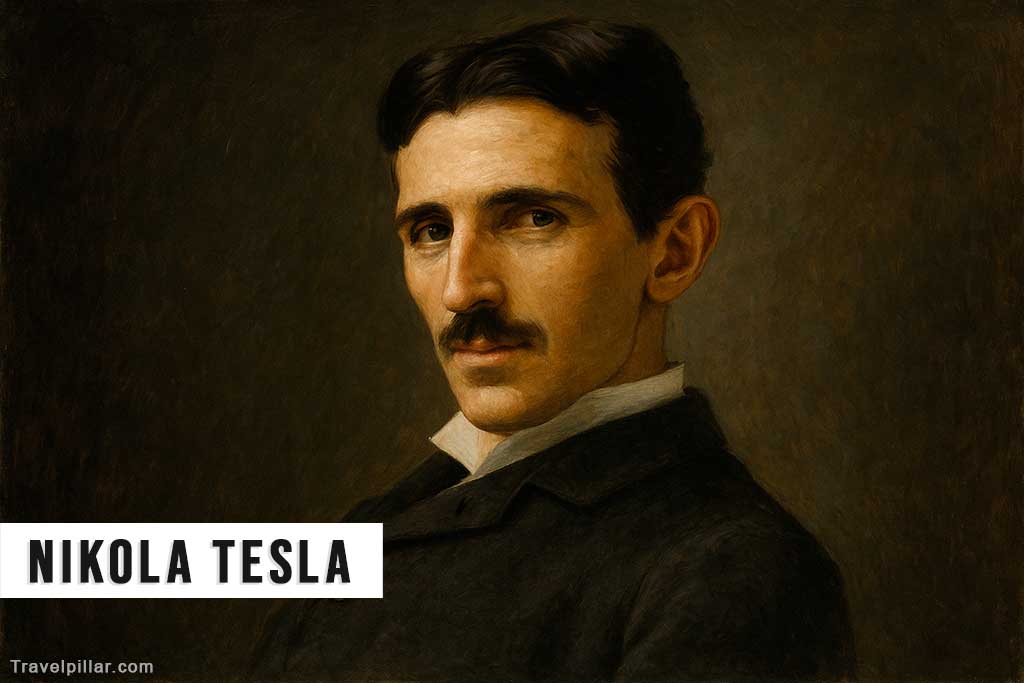
Nikola Tesla, born on July 10, 1856, in Smiljan, then part of the Austrian Empire, now Croatia, was an inventor, electrical engineer, mechanical engineer, and physicist who is best known for his contributions to the design of the modern alternating current (AC) electricity supply system.
Tesla studied electrical engineering at the Austrian Polytechnic in Graz. In 1884, he emigrated to the United States, where he started working for Thomas Edison in New York City. However, his ideas on alternating current were at odds with Edison’s support for direct current. This led Tesla to set up his own laboratory and begin experimenting with AC.
Tesla patented the Tesla coil in 1891, which is still used in radio technology today. However, his most significant contribution was the development of the alternating current electrical system. He showcased the safety and efficiency of AC power at the 1893 World’s Columbian Exposition in Chicago, which played a significant role in its adoption over direct current.
Despite his numerous inventions and his visionary ideas on wireless communication and energy, Tesla died in relative obscurity on January 7, 1943, in New York City. Many of his ideas were so advanced that it took years, even decades, for their full impact to be appreciated.
In recent years, there has been a resurgence of interest in Tesla and his work. His ideas have inspired modern electric vehicles and wireless technology. His vision of providing free, wireless electricity to the world remains an inspiring, albeit unfulfilled, dream.
Tesla’s life and work represent the quintessential “mad scientist.” He was a man of massive intellect and foresight, and his inventions and theories laid much of the groundwork for modern electrical and communication systems. His contribution to the field of electrical engineering is enormous, and his work continues to influence technology today.