
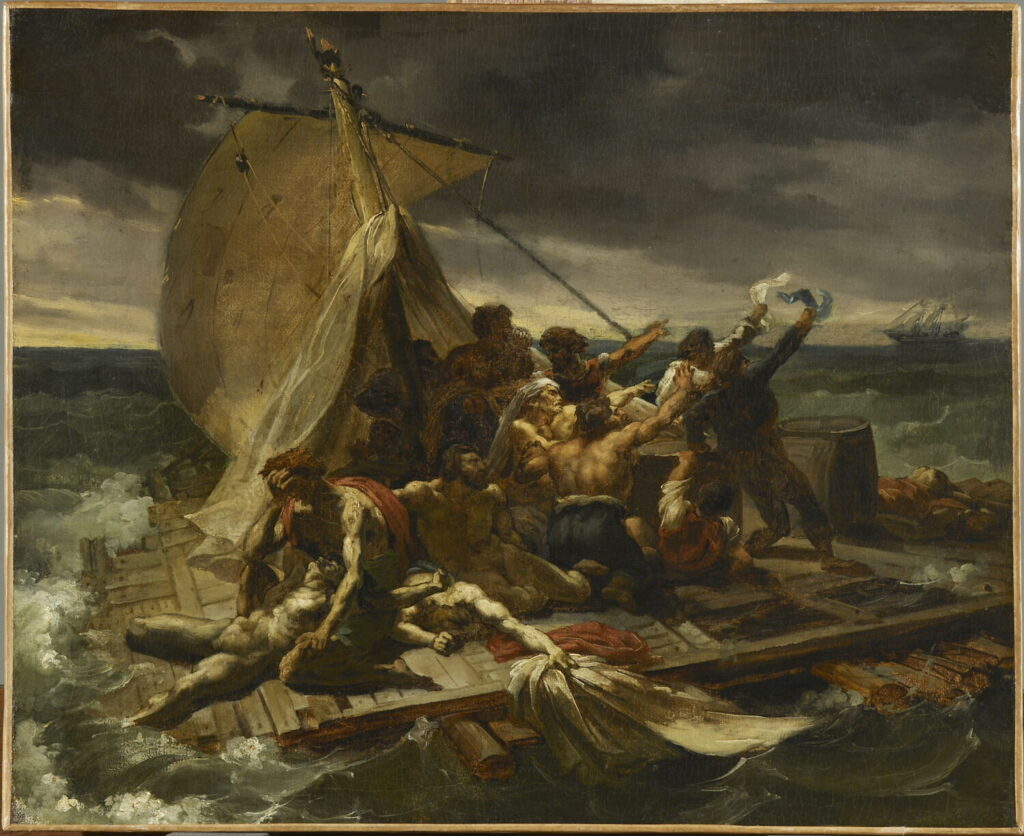
Hanging in the Louvre Museum in Paris, The Raft of the Medusa is one of the most powerful paintings of the French Romantic period. Painted between 1818 and 1819 by the French artist Théodore Géricault, the enormous canvas depicts the aftermath of a real maritime disaster that shocked France during the early 19th century. Unlike traditional historical paintings celebrating military victories or heroic rulers, this work focused on ordinary people caught in desperation, suffering and political failure.
The painting shows survivors stranded on a makeshift raft after the French naval frigate Méduse ran aground off the coast of West Africa in 1816. Around 150 people were abandoned at sea with little food or water after lifeboats towing the raft cut it loose. By the time rescue arrived nearly two weeks later, only a handful remained alive. Reports of starvation, violence and cannibalism caused a major scandal in France, particularly because the ship’s captain had reportedly gained his position through political connections rather than competence.
Géricault became obsessed with the tragedy and carried out extensive research before beginning the painting. He interviewed survivors, studied corpses in hospital morgues to understand the appearance of dead bodies, and even constructed a scale model of the raft in his studio. This commitment to realism gave the painting an unusual intensity that shocked audiences when it was first exhibited.
The composition is carefully structured to guide the viewer from death and despair in the foreground toward a distant possibility of rescue on the horizon. The figures form a rising triangular arrangement that builds emotional tension while also symbolising fragile hope. Géricault used dramatic lighting, stormy skies and expressive human gestures to heighten the emotional impact without turning the scene into pure fantasy.
Many people consider The Raft of the Medusa a masterpiece because it changed expectations about what serious art could depict. Rather than glorifying power, the painting confronted political incompetence and human suffering directly. It also influenced later Romantic and realist artists who sought to portray modern events with emotional honesty.
Today, standing before the vast canvas in the Louvre Museum remains an overwhelming experience. The painting is not only a historical image but also a reminder of how art can transform a contemporary disaster into a lasting reflection on survival, politics and human resilience.
Weblink: https://collections.louvre.fr/en/