
https://www.musee-orsay.fr/en/artworks/le-dejeuner-sur-lherbe-904
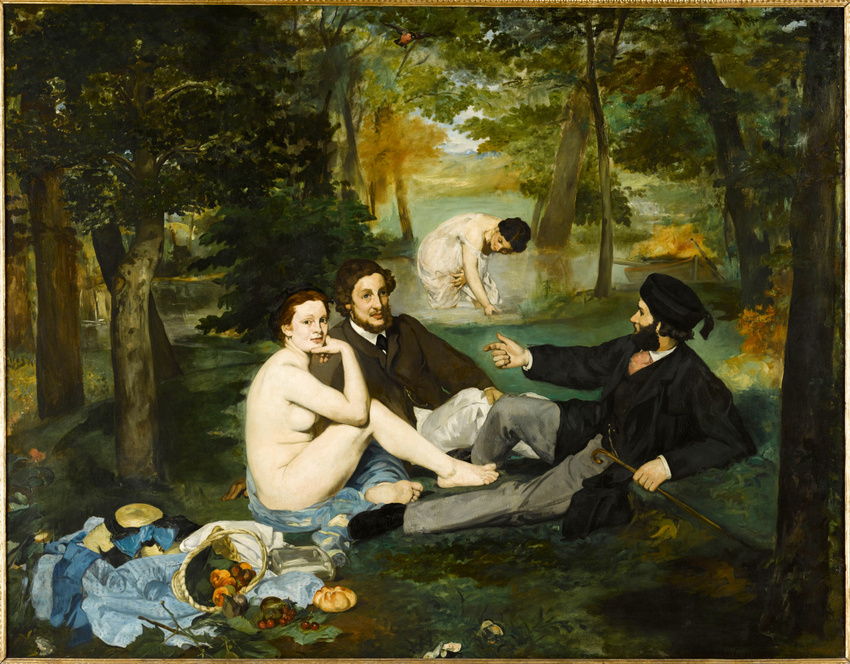
When Le Déjeuner sur l’herbe by Édouard Manet was first shown in 1863, it caused outrage. Not because it included a nude woman — Parisian audiences were used to mythological Venuses — but because this woman was not pretending to be a goddess. She sits calmly beside two fully dressed men in modern clothing, looking directly at the viewer as if aware of being observed.
The composition was inspired by Renaissance works, including a pastoral scene associated with Giorgione and engravings after Raphael. In those earlier images, nude figures represented mythological nymphs in idealised landscapes. Manet removed the mythology but kept the structure. The result feels unsettling. The classical framework remains, yet the excuse of ancient legend has vanished.
The men are believed to be based on Manet’s brother and future brother-in-law. They appear relaxed, engaged in conversation, seemingly unconcerned by their companion’s nudity. The woman’s direct gaze is crucial. She does not appear embarrassed or vulnerable. Instead, she confronts the viewer, reversing the traditional dynamic in which the nude exists only to be admired.
In the background, a second lightly clothed woman bathes in a stream. Her scale appears strangely large, creating a sense of spatial ambiguity. Some interpret this as deliberate flattening, but it also adds to the dreamlike quality of the scene. The picnic itself — bread, fruit and discarded clothing — symbolises leisure, yet the social codes of 19th-century Paris make the encounter ambiguous. Many viewers interpreted the woman as a model or courtesan rather than an innocent participant in a rural outing.
The painting was rejected by the official Salon and exhibited instead at the Salon des Refusés, where critics mocked it. Yet its challenge was profound. By placing a modern woman into a composition traditionally reserved for gods and nymphs, Manet forced viewers to question the boundary between artifice and reality. The scene still feels provocative because it offers no clear narrative, only a confrontation between viewer and subject.
https://www.musee-orsay.fr/en/artworks/le-dejeuner-sur-lherbe-904