
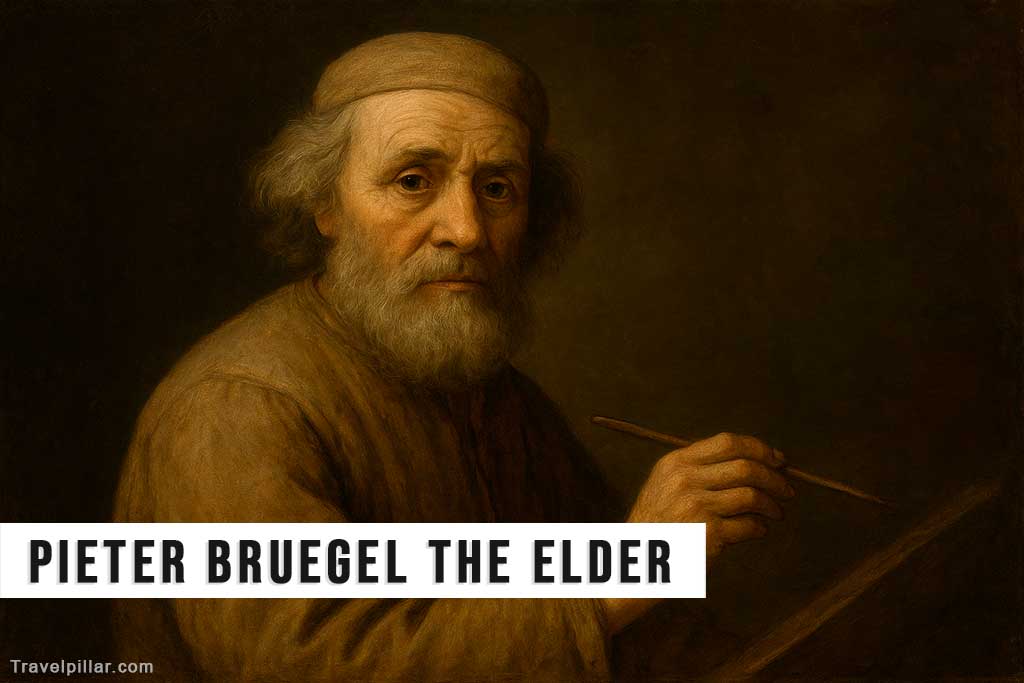
Pieter Bruegel the Elder (c. 1525–1569) was a prominent Flemish Renaissance painter and printmaker, renowned for his detailed landscapes, depictions of peasant life, and allegorical works. He is often regarded as one of the most important artists of the 16th century, with a legacy that influenced both his contemporaries and subsequent generations.
Bruegel’s early life remains largely undocumented, though he likely trained under Pieter Coecke van Aelst, a prominent artist in Antwerp. By the mid-1550s, he was associated with the Guild of Saint Luke in Antwerp and traveled extensively through Italy. His exposure to Italian Renaissance art influenced his techniques, though his works retained a distinctly Northern European focus on detail and realism.
Bruegel’s artistic oeuvre is characterized by intricate compositions, rich in symbolism and social commentary. His works often reflect the cultural and political tensions of his time, as well as universal themes of human folly and morality. His landscapes, such as The Tower of Babel (1563), display meticulous attention to architectural and natural elements, often serving as allegories for human ambition and its consequences.
Perhaps his most famous works are his depictions of peasant life, including The Peasant Wedding (1567) and The Harvesters (1565). These paintings provide a vivid portrayal of 16th-century rural life, capturing both its hardships and moments of joy. Bruegel’s ability to depict the mundane and the universal simultaneously earned him the nickname “Peasant Bruegel.”
Bruegel’s Triumph of Death (c. 1562) and other moralistic works reflect the anxieties of his era, marked by religious upheaval and societal change. His mastery of detail and ability to weave narrative into complex compositions demonstrate his innovative approach to painting.
Bruegel’s artistic legacy endured through his sons, Pieter Brueghel the Younger and Jan Brueghel the Elder, who became accomplished painters in their own right. Today, many of his works are housed in major institutions, including the Kunsthistorisches Museum in Vienna, which holds the largest collection of his paintings. Pieter Bruegel the Elder remains a seminal figure in Western art history, celebrated for his fusion of realism, allegory, and social commentary.