
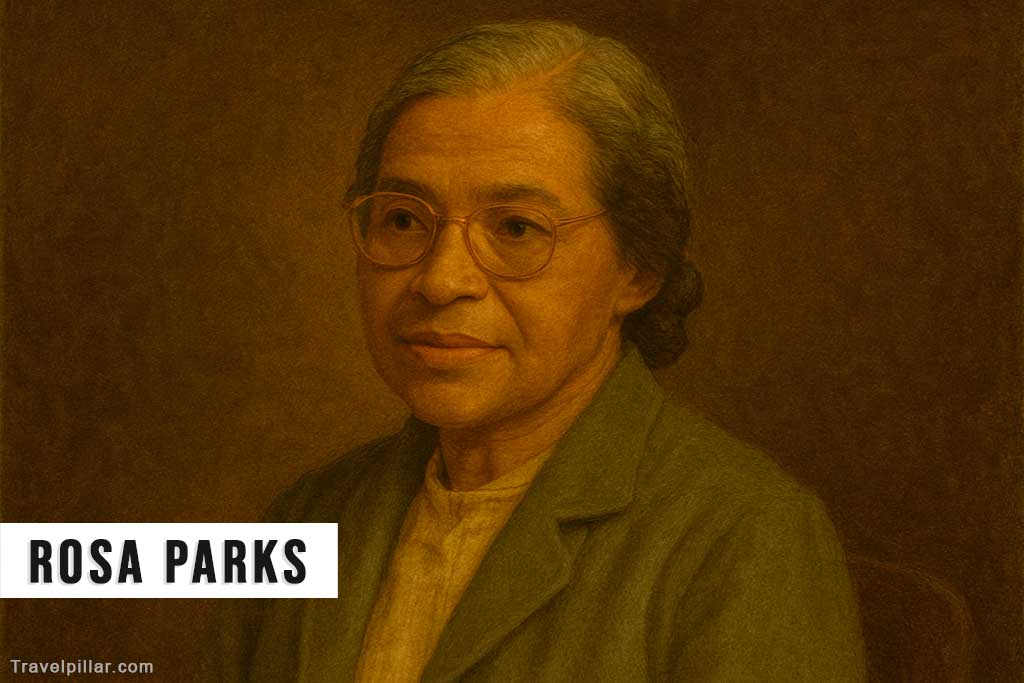
Rosa Parks, born on February 4, 1913, in Tuskegee, Alabama, was an African American civil rights activist whose refusal to relinquish her seat on a segregated bus to a white person sparked the Montgomery Bus Boycott, a pivotal event in the U.S. Civil Rights Movement.
Parks worked as a seamstress and was also active in the National Association for the Advancement of Colored People (NAACP), serving as the secretary for its Montgomery chapter. Despite the unyielding racial segregation in the South, Parks remained committed to the fight for social justice.
Her moment of profound impact occurred on December 1, 1955. After a long day’s work, Parks was seated in the “colored section” of a Montgomery bus when she was told to give up her seat for a white man. Parks refused and was subsequently arrested.
This act of defiance led to the Montgomery Bus Boycott, a 381-day protest against the city’s segregated public transport system, coordinated by a young Martin Luther King Jr. This boycott proved successful, leading to a Supreme Court ruling that segregation on public buses was unconstitutional.
Despite losing her job and experiencing harassment, Parks continued her activism, moving to Detroit in 1957 where she fought against housing segregation and worked for U.S. Representative John Conyers.
Parks passed away on October 24, 2005. Throughout her life, she received numerous accolades for her role in the Civil Rights Movement, including the Presidential Medal of Freedom and the Congressional Gold Medal. Rosa Parks is remembered as a symbol of dignity and strength in the struggle against racial injustice. Her quiet act of defiance had a profound impact on American society, serving as a catalyst for landmark civil rights reforms and helping to shift public opinion on racial segregation.