
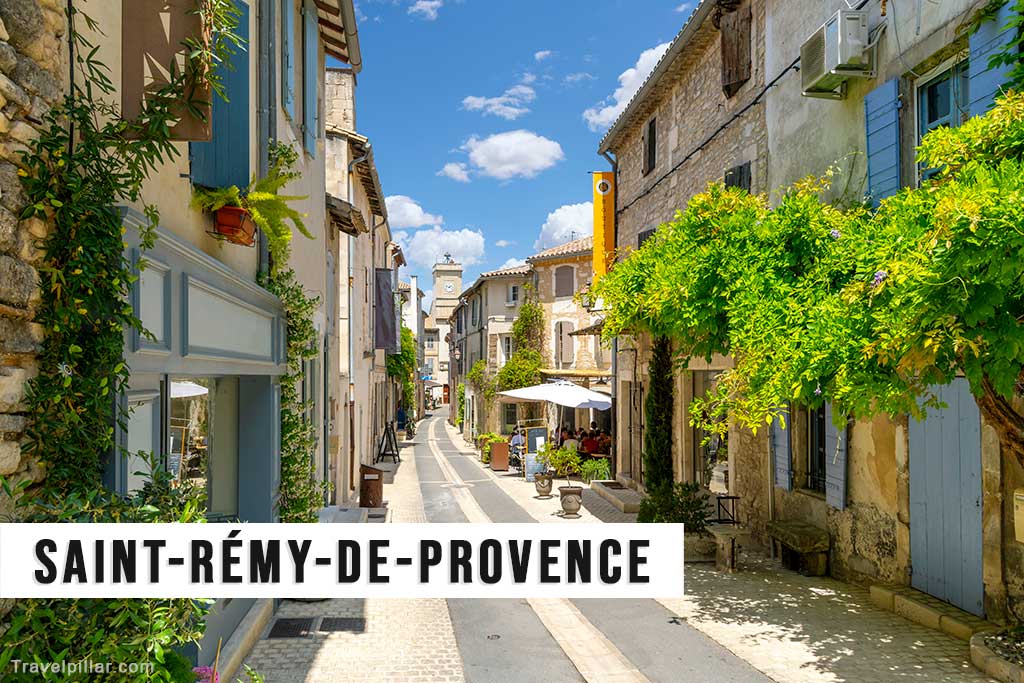
Saint-Rémy-de-Provence is a small town located in the Bouches-du-Rhône department in southern France, within the historical region of Provence. It lies at the northern edge of the Alpilles mountain range and approximately 20 kilometers south of Avignon. The town is known for its Roman heritage, cultural associations, and traditional Provençal architecture.
Just outside the town are the remains of Glanum, an ancient Gallo-Roman settlement founded in the 6th century BCE and later developed under Roman rule. The site includes remnants of public baths, temples, and residential structures, along with two well-preserved monuments: the Triumphal Arch and the Mausoleum of the Julii. These free-standing Roman structures date from the first century BCE and are collectively known as Les Antiques.
Saint-Rémy’s historical centre features narrow streets, old stone buildings, small squares, and fountains. Many of the structures date from the medieval and early modern periods. The Collégiale Saint-Martin, a 19th-century neo-classical church, occupies the site of an earlier medieval church. The town also contains a number of private mansions, now repurposed as galleries, shops, and municipal buildings.
One of the town’s most notable associations is with the Dutch painter Vincent van Gogh. From May 1889 to May 1890, Van Gogh lived at the Saint-Paul-de-Mausole asylum, located in a former monastery just south of the town. During his stay, he created several major works, including The Starry Night, inspired by the surrounding landscape and views from his room. Today, visitors can access the monastery grounds and see reconstructions of the spaces where he worked.
The local economy includes agriculture, particularly the production of olive oil, wine, and aromatic plants. Weekly markets, held in the town centre, offer regional produce and contribute to the area’s commercial activity. The surrounding countryside is characterised by vineyards, olive groves, and limestone hills.
Saint-Rémy-de-Provence is a small but historically layered town, combining Roman archaeology, artistic legacy, and rural Provençal character. Its proximity to the Alpilles and preserved built environment make it a destination of cultural and regional interest.
Google map Town
Google map Glanum Archaeological Site 4.5/5
Google map Château des Baux-de-Provence (outside town) 4.6/5
Google map The Antiquities of Glanum 4.4/5
Google map Alpilles Natural Regional Park (outside town) 4.6/5
Google map Monastery Saint-Paul de Mausole 4.4/5
Google map Musée Estrine – Présence Van Gogh 4.3/5