
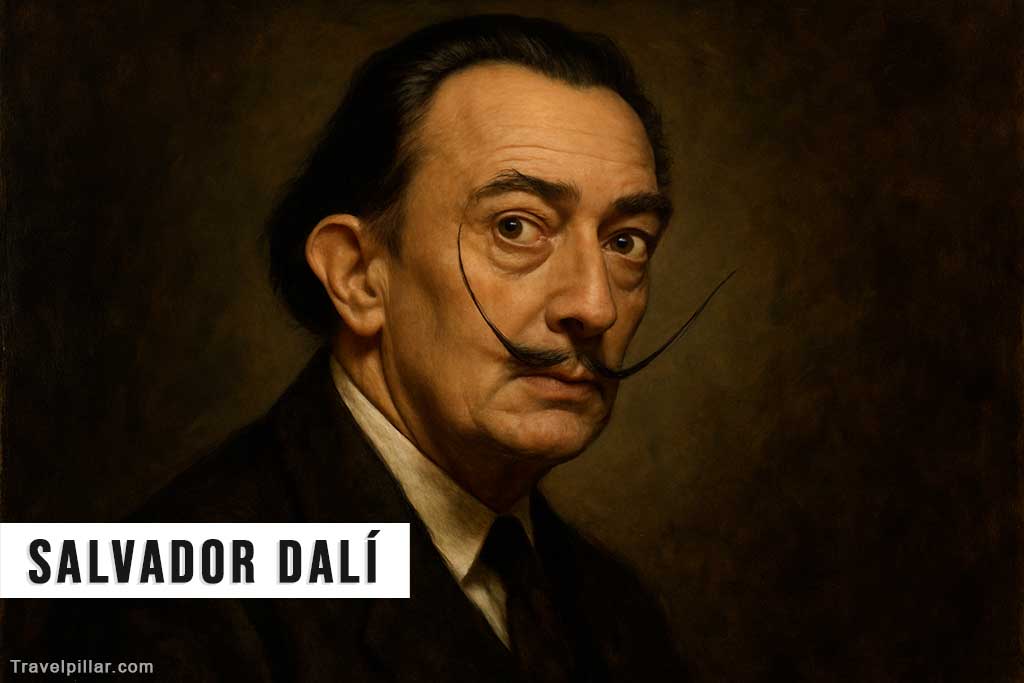
Salvador Dalí (1904-1989) was a pivotal figure in the Surrealist movement, which transformed the landscape of modern art in the 20th century. Born in Figueres, Spain, Dalí’s innovative artistic practice was marked by his profound understanding of Sigmund Freud‘s theories of the unconscious and his exceptional ability to transmute psychoanalytic concepts into visually arresting images.
Dalí’s work often integrated bizarre dream sequences, using what he called the “paranoiac-critical method” – a spontaneous method of irrational knowledge based on the critical and systematic objectification of delirious associations and interpretations. The visual language of his artwork included melting clocks, floating objects, and fantastical creatures, which became his distinctive signature.
“The Persistence of Memory” (1931), his most famous work, embodies this surrealistic style. In this iconic painting, Dalí utilizes melting pocket watches to challenge the concept of rigid and linear time, reflecting the fluidity and mutability of the dream state.
Beyond painting, Dalí was a true multimedia artist who experimented with film, sculpture, and photography. His collaboration with filmmaker Luis Buñuel on “Un Chien Andalou” (1929) and “L’Age d’Or” (1930) produced some of the most enduring images of the Surrealist movement.
Dalí’s public persona was as flamboyant as his art. He was well-known for his eccentric behavior, outrageous statements, and ostentatious sartorial style. These antics, however, often overshadowed his serious artistic pursuits and led to his expulsion from the Surrealist group in 1934.
Despite the controversies that trailed his career, Salvador Dalí’s contributions to modern art are indisputable. His works continue to inspire artists and captivate audiences around the world, making him an enduring icon of the Surrealist movement.