
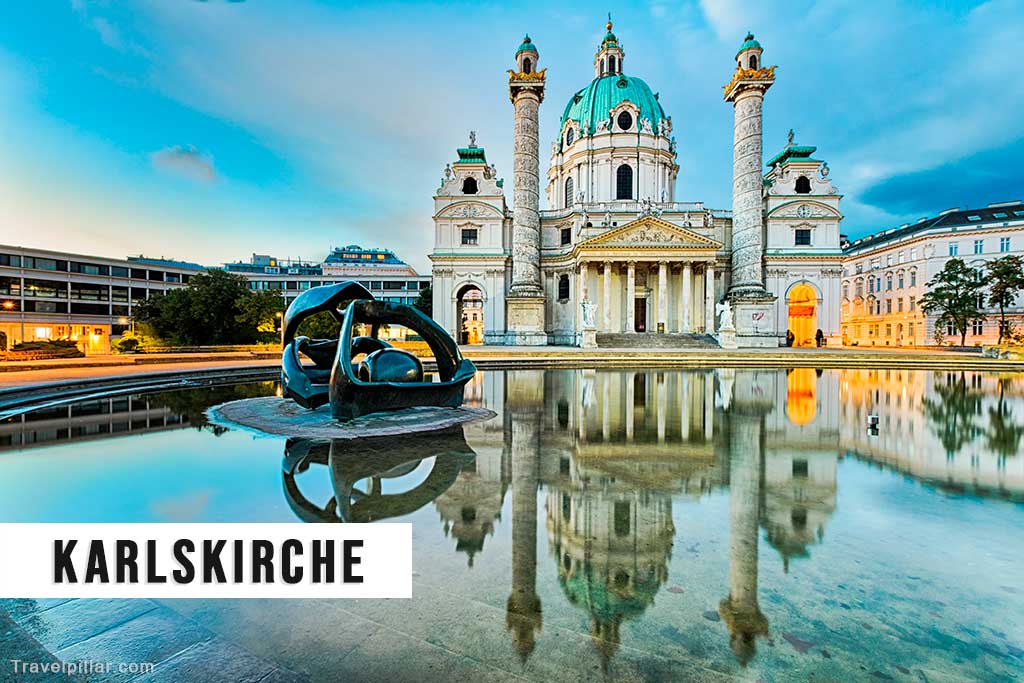
Karlskirche, or St. Charles Church, is a prominent religious edifice located in Vienna, Austria, and one of the most remarkable examples of Baroque architecture in Europe. It was designed by Johann Bernhard Fischer von Erlach, a leading Austrian architect of the era, and his son, Joseph Emanuel Fischer von Erlach, who completed the work after his father’s death. Construction began in 1716, initiated by Emperor Charles VI, and was completed in 1737.
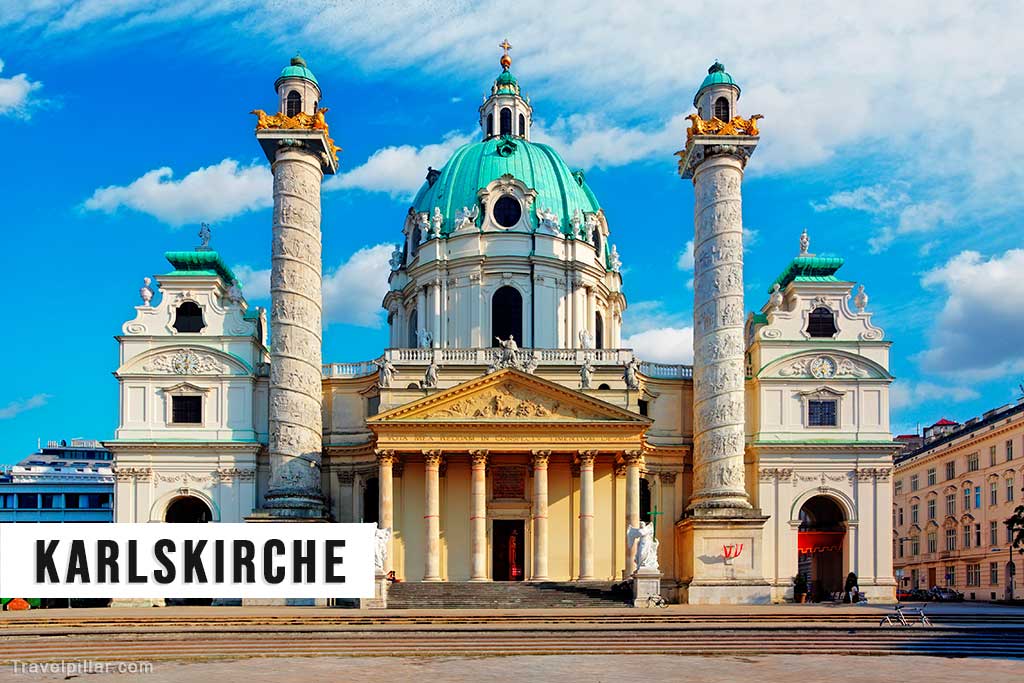
The church was commissioned following the last great plague epidemic that swept Vienna in 1713. The emperor vowed to build a church dedicated to St. Charles Borromeo, a 16th-century Italian bishop who was renowned for his care of plague victims. The resulting edifice was to serve both as a place of worship and a monument celebrating the end of the plague.
Standing at the edge of the Karlsplatz, the structure’s majestic façade immediately commands attention. The church integrates diverse architectural styles, including a Greek-style portico, Roman triumphal columns, and a Baroque dome. The façade is flanked by two columns, reminiscent of Trajan’s Column in Rome, adorned with spiral relief depicting scenes from the life of St. Charles Borromeo.
The dome, rising to a height of 72 meters, is a key feature of the Viennese skyline. It is elliptical rather than circular, a unique aspect that sets it apart from many other Baroque structures. The interior of the church is no less impressive, boasting frescoes, ornate stucco work, and an altarpiece portraying the ascension of St. Charles Borromeo.
Karlskirche remains an active place of worship and a significant tourist attraction. Its historical and architectural value, along with its idyllic setting near the Vienna University of Technology and the Musikverein, contributes to its status as a central cultural landmark within Vienna. Through its distinct fusion of architectural styles, Karlskirche embodies the innovation and grandeur of the Baroque era.
Official website: https://www.karlskirche.at/en/
Google map 4.6/5