
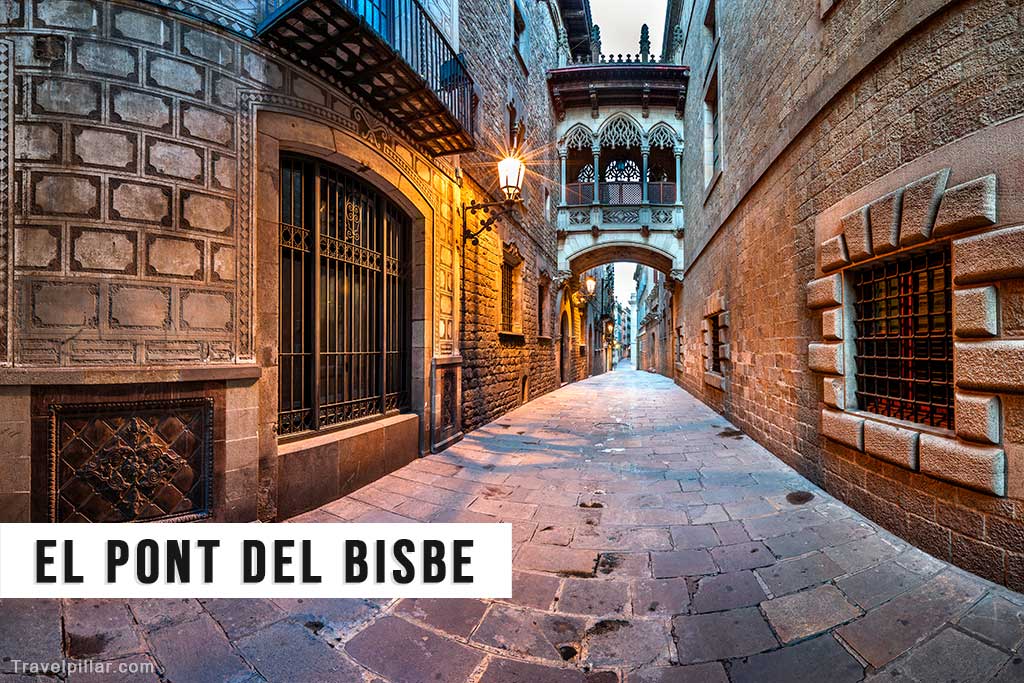
El Pont del Bisbe, or the Bishop’s Bridge, is a neo-Gothic structure located in the Gothic Quarter of Barcelona. It spans Carrer del Bisbe, a narrow street that connects the Plaça de Sant Jaume to the area around the Cathedral of Barcelona. Despite its medieval appearance, the bridge was constructed in 1928 as part of a wider project to revitalise and reconstruct sections of the Gothic Quarter during the early 20th century.
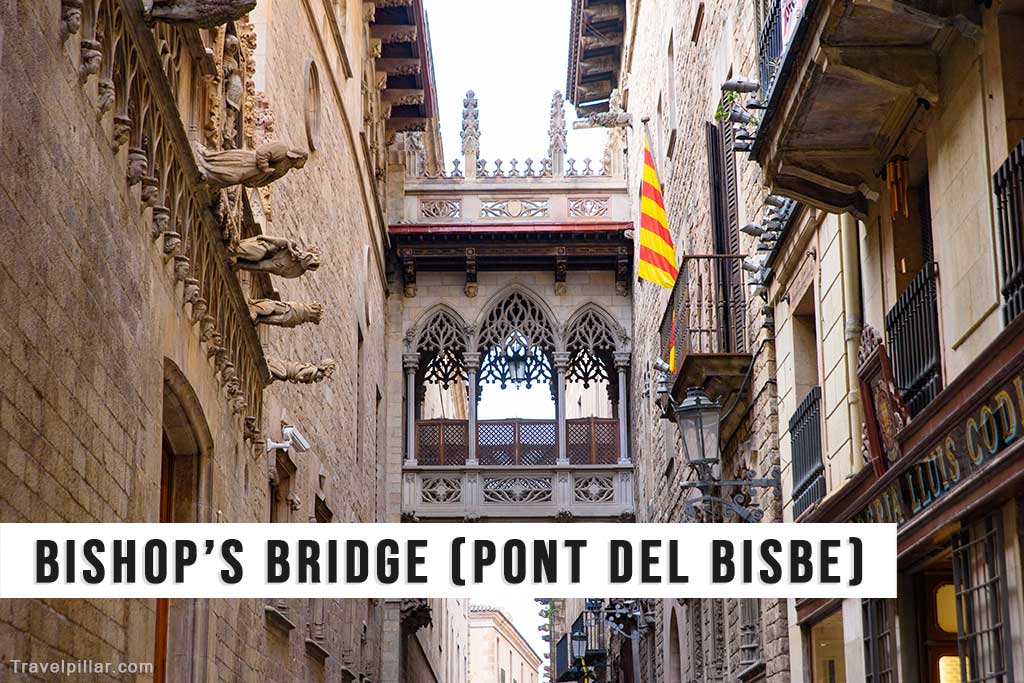
The bridge links two historic buildings: the Palau de la Generalitat, the seat of the Catalan government, and the Casa dels Canonges, the residence of the president of the Generalitat. Designed by architect Joan Rubió i Bellver, a disciple of Antoni Gaudí, the bridge was created in a neo-Gothic style that aimed to harmonise with the surrounding medieval architecture. Its pointed arch, tracery, and decorative elements such as stone gargoyles and ornamental carvings are reminiscent of authentic Gothic design.
A notable feature of El Pont del Bisbe is the carved skull pierced by a dagger located on the underside of the bridge. This detail has given rise to urban legends, one of which claims that removing the skull would bring a curse upon the city. While fictional, the legend has contributed to the bridge’s popularity as a photographic subject and point of interest.
The bridge does not serve a functional structural purpose but was intended as an aesthetic addition to unify the area visually and enhance the Gothic character of the quarter. It reflects a broader cultural movement in early 20th-century Barcelona that sought to celebrate and reinterpret the city’s medieval heritage through architecture and urban design.
El Pont del Bisbe is now one of the most recognisable landmarks in the Gothic Quarter. Although not a genuine medieval construction, its stylistic integration and symbolic location have made it an enduring feature of Barcelona’s historic cityscape. It is frequently included in walking tours and serves as a popular backdrop for visitors exploring the area.
Google map 4.6/5