
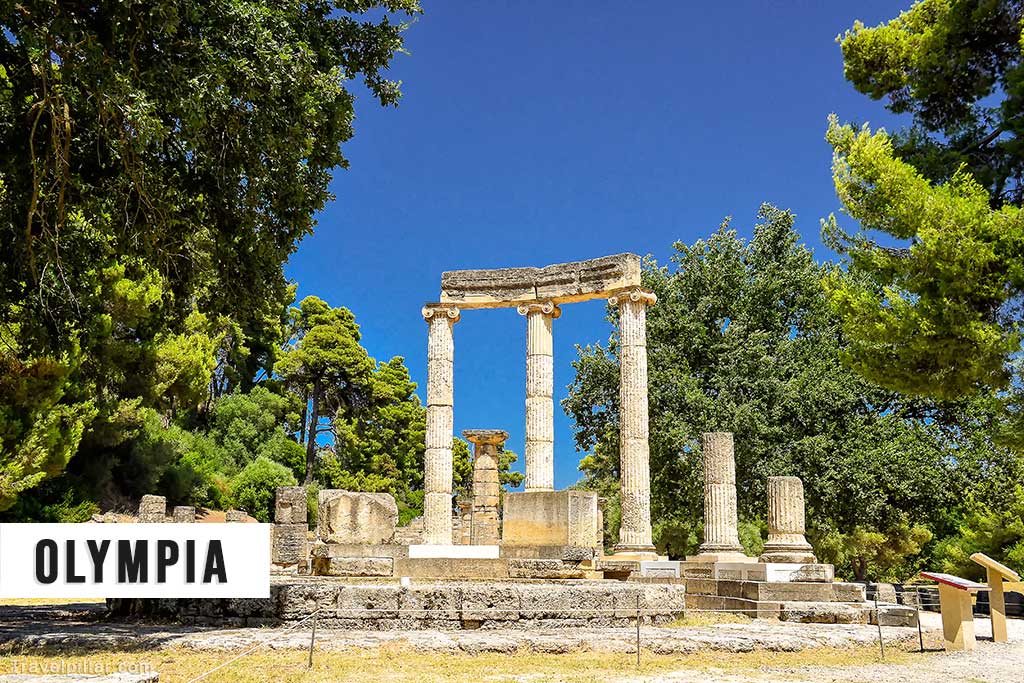
Olympia, located in the western Peloponnese, is one of the most important archaeological sites in Greece. It was the sanctuary of Zeus and the birthplace of the ancient Olympic Games, which were held every four years from 776 BCE. The site was a major religious centre, attracting pilgrims from across the Greek world.
The archaeological site includes the ruins of various temples, training areas, and athletic facilities. The most significant structure is the Temple of Zeus, once housing one of the Seven Wonders of the Ancient World – the gold and ivory statue of Zeus crafted by Phidias. Nearby, the Temple of Hera is one of the oldest monumental temples in Greece, dating to the 7th century BCE.
Other notable features include the ancient stadium, which could accommodate around 45,000 spectators. The starting and finishing lines of the track, made of stone, are still visible. Adjacent to the stadium is the gymnasium and the palaestra, where athletes trained before the games. The Philippeion, a circular memorial built by Philip II of Macedon, and the Leonidaion, a guesthouse for distinguished visitors, are also part of the complex.
The Archaeological Museum of Olympia houses many of the site’s most important finds, including the sculptures from the Temple of Zeus and the famous statue of Hermes by Praxiteles. The museum provides context for understanding the religious and athletic significance of the site.
Today, Olympia remains a symbol of the Olympic spirit. The Olympic flame is still lit here before every modern Olympic Games. Though only ruins remain, the layout and preserved elements offer insight into ancient Greek religion, art, and athletics. The site is surrounded by olive trees and low hills, contributing to its sense of historical continuity and geographical isolation from modern development.
Official website for tickets: https://hhticket.gr/
Google map 4.7/5