
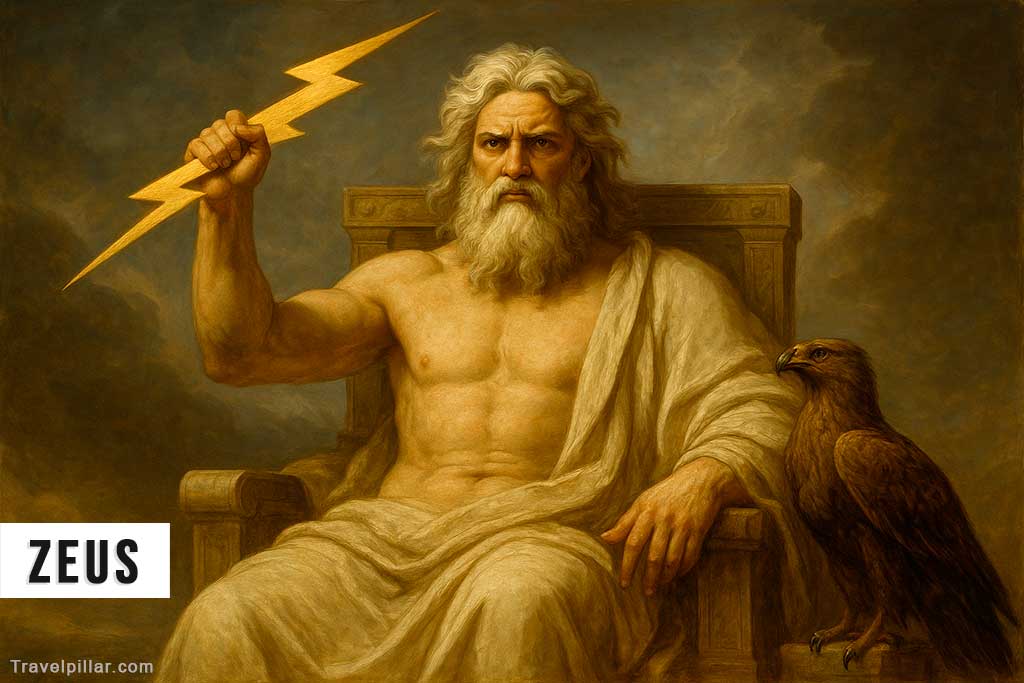
Zeus, the king of the Greek gods, is a central figure in ancient Greek mythology. Often depicted as a regal and powerful figure, Zeus was believed to rule over Mount Olympus, the home of the gods, and was associated with the sky, thunder, and lightning. His influence extended across all realms of the cosmos, symbolizing authority, order, and law. In Greek mythology, Zeus was the child of the Titans Cronus and Rhea. To prevent being overthrown by his offspring, Cronus devoured each of his children at birth. However, Rhea saved Zeus by hiding him in a cave on the island of Crete and giving Cronus a stone wrapped in swaddling clothes to swallow instead. When Zeus reached maturity, he forced Cronus to disgorge his siblings—Hestia, Demeter, Hera, Hades, and Poseidon—who joined him in a rebellion against the Titans. After a protracted conflict known as the Titanomachy, Zeus and his siblings emerged victorious, establishing the rule of the Olympian gods.
Zeus was known for wielding the thunderbolt, a symbol of his power and a weapon used to enforce his will. His authority was absolute among the gods, though it was not without its challenges and complexities. The mythology surrounding Zeus is filled with tales of his relationships, both with other deities and mortals. His numerous liaisons, often resulting in the birth of many other gods and heroes, illustrate his dominant yet capricious nature.
Zeus’s domain extended beyond Olympus. He was worshipped across the Greek world, with major sanctuaries dedicated to him, such as the temple at Olympia, where the ancient Olympic Games were held in his honor. The statue of Zeus at Olympia, one of the Seven Wonders of the Ancient World, underscored his prominence in Greek culture and religion.
While he embodied strength and justice, he also personified the complexities of the gods’ interaction with the human world. He was both protector and punisher, overseeing the fates of mortals while indulging in his desires. His myths have been passed down through centuries, influencing Western literature, art, and philosophy. Understanding Zeus and his narratives offers insight into ancient Greek society, its values, and its perceptions of divine power. His legacy continues to be felt in cultural references and the study of classical mythology.