
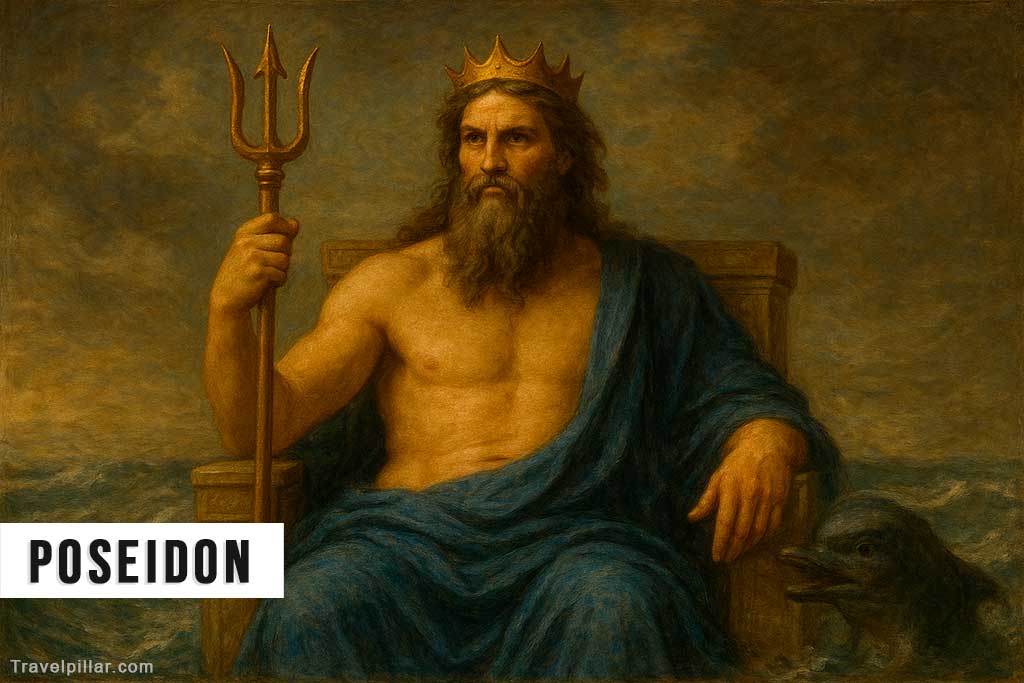
Poseidon, one of the principal deities of ancient Greek mythology, was the god of the sea, earthquakes, and horses. As one of the twelve Olympian gods, he held significant power and influence over the natural world, particularly the oceans and waters. Often depicted holding a trident, Poseidon was known for his tempestuous and unpredictable nature, reflecting the volatile characteristics of the sea itself.
The mythology of Poseidon is rooted in his birth as the son of the Titans Cronus and Rhea. Like his siblings, he was swallowed by his father and later rescued by Zeus. After the defeat of the Titans, the three brothers—Zeus, Poseidon, and Hades—divided the cosmos among themselves. Poseidon took dominion over the sea, while Zeus ruled the sky and Hades the underworld. This division established Poseidon as a key figure governing the earth’s waters and the forces associated with them.
Poseidon was worshipped extensively by those whose lives were connected to the sea, including sailors, fishermen, and coastal communities. His influence was considered both protective and destructive. While he could calm waters and ensure safe voyages, he was also capable of unleashing storms, causing shipwrecks, and triggering earthquakes. His dual nature was reflected in his many epithets, ranging from “Earth-Shaker” to “Savior of Ships.”
The god was also closely linked with horses, often credited with their creation. In some myths, he is said to have struck the earth with his trident, giving rise to the first horse. This association made him a patron of horse racing and chariot driving, activities prominent in ancient Greek culture.
Poseidon’s mythology is filled with stories of his interactions with gods, mortals, and mythical creatures. One of his most famous myths involves the contest with Athena for the patronage of Athens. Poseidon offered the gift of a saltwater spring by striking the Acropolis with his trident, while Athena provided the olive tree. The citizens of Athens chose Athena’s gift, leading to a longstanding rivalry between the two deities.
Sanctuaries dedicated to Poseidon were often located near coastlines, with the Temple of Poseidon at Cape Sounion being among the most famous. These temples were sites of worship and pilgrimage, reflecting his significance in Greek society. Understanding Poseidon’s role in mythology provides insights into ancient Greek attitudes toward the sea, natural phenomena, and the gods’ influence over human life.