
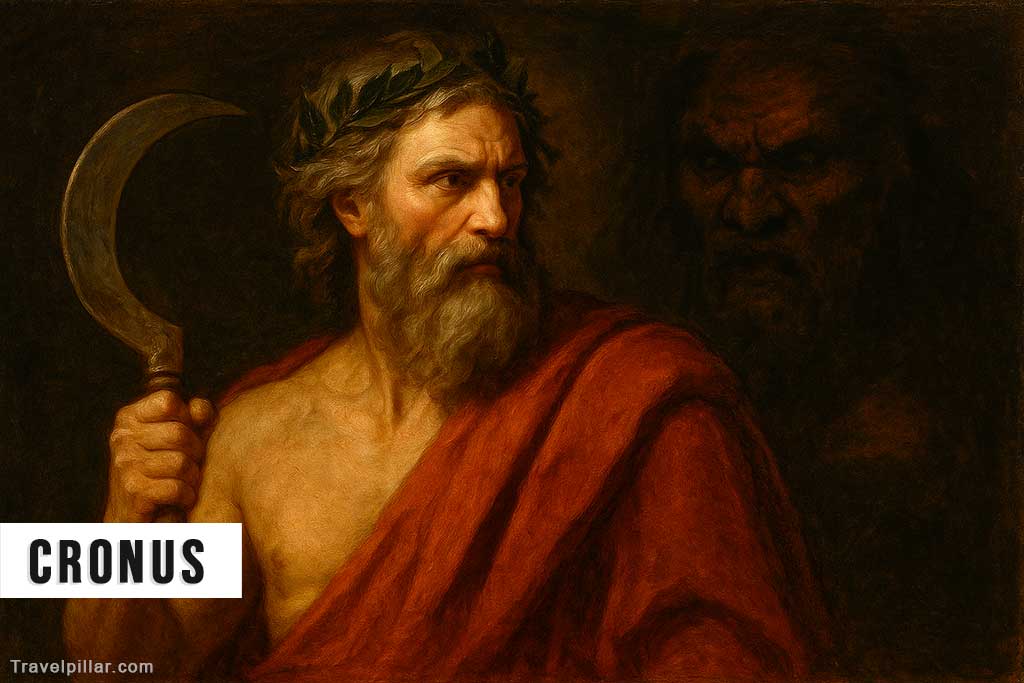
Cronus, a central figure in Greek mythology, is the leader of the Titans and the god of time, particularly its destructive and all-consuming aspect. He was the son of Uranus (the sky) and Gaia (the earth), two primordial deities. Cronus is best known for overthrowing his father Uranus and becoming the ruler of the universe during the Golden Age, a period of prosperity and abundance in Greek mythology.
The overthrow of Uranus came after Gaia, angered by Uranus’ imprisonment of their children, conspired with Cronus to defeat him. Gaia provided Cronus with a sickle, which he used to castrate Uranus, marking the end of Uranus’ reign. From the blood of Uranus, other mythological figures, including the Furies and Giants, were born. After taking control, Cronus became the leader of the Titans and ruled during the Golden Age, a time when humanity was said to live in peace and harmony.
Cronus married his sister Rhea, and together they had six children: Hestia, Demeter, Hera, Hades, Poseidon, and Zeus. However, fearing a prophecy that one of his children would overthrow him, Cronus swallowed each child at birth. Rhea, distressed by the loss of her children, managed to save the youngest, Zeus, by hiding him in a cave in Crete. She tricked Cronus by giving him a stone wrapped in swaddling clothes, which he swallowed, thinking it was his son.
Eventually, Zeus grew up and, with the help of Rhea, forced Cronus to regurgitate his siblings. This act led to the Titanomachy, a ten-year war between the Olympian gods, led by Zeus, and the Titans, led by Cronus. Zeus and his siblings emerged victorious, overthrowing Cronus and the Titans, marking the beginning of the reign of the Olympian gods.
Cronus was later exiled, and his story became a symbol of the inevitable passage of time and the cyclical nature of power in Greek mythology. While his direct worship was rare, his legacy is closely tied to the transition from the Titans to the Olympians in the mythological hierarchy.