
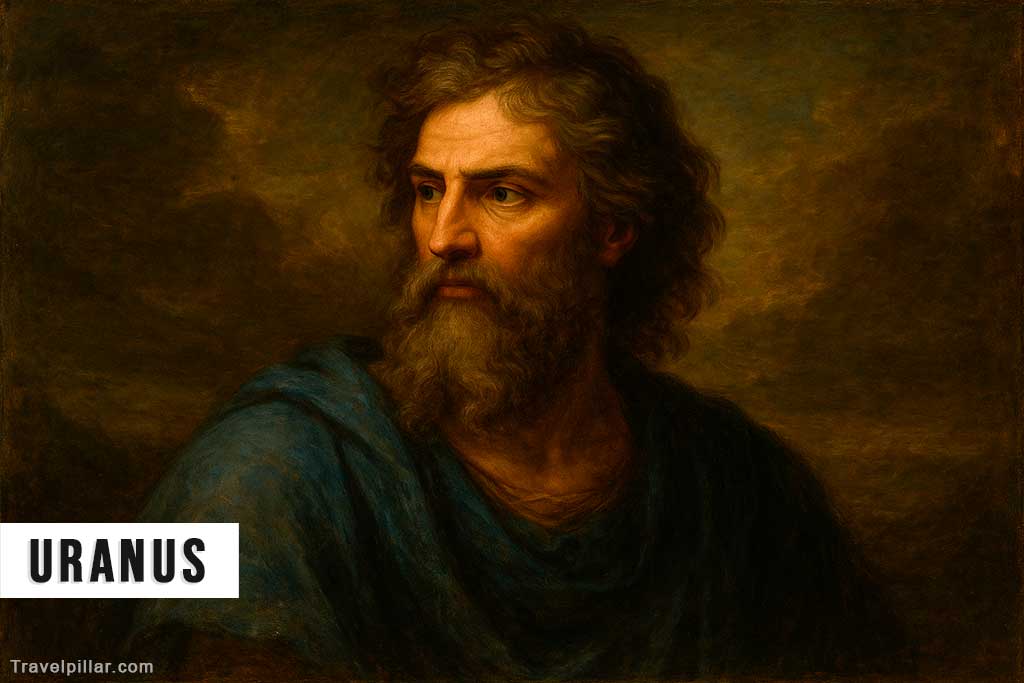
Uranus, in Greek mythology, is the primordial god of the sky and one of the earliest deities in the Greek creation myth. He personifies the heavens and was the son and consort of Gaia, the Earth. Together, they produced many of the foundational figures of Greek mythology, including the Titans, the Cyclopes, and the Hecatoncheires (hundred-handed giants). Uranus plays a crucial role in the cosmogony of the universe, marking the first generation of divine beings in Greek myth.
Uranus is best known for his complex relationship with Gaia and their offspring. Fearing the power and potential threat posed by his children, Uranus imprisoned the Cyclopes and the Hecatoncheires deep within the Earth. This act angered Gaia, leading her to conspire with her son Cronus, one of the Titans, to overthrow Uranus. Gaia provided Cronus with a sickle, and Cronus ambushed Uranus, castrating him. The blood from Uranus’ wound fell onto the Earth, and from it, new beings such as the Erinyes (Furies) and the Giants were born. The severed genitals fell into the sea, giving rise to Aphrodite, the goddess of love and beauty.
After his defeat, Uranus retreated from active involvement in the myths, and the reign of the Titans began. Cronus took his place as the ruler of the cosmos, only to later face a similar fate at the hands of his own son, Zeus, in the next generation of divine conflict.
Uranus himself was not widely worshipped in ancient Greece, as his role in mythology is more symbolic and limited to the early stages of creation. However, his legacy remains integral to understanding the succession of divine powers in Greek myth, from the primordial gods to the Olympians. His overthrow by Cronus reflects a recurring theme in Greek mythology of the conflict between generations of gods, highlighting the shifting balance of power in the divine hierarchy.