
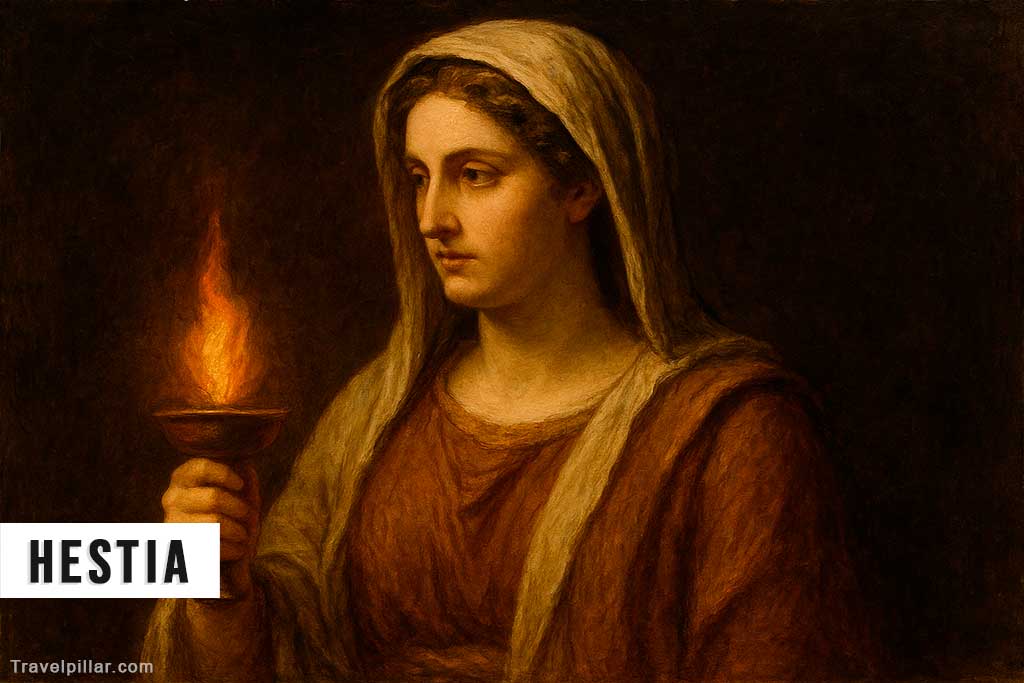
Hestia, the ancient Greek goddess of the hearth, home, and family, was a central figure in Greek domestic and civic life. As the daughter of the Titans Cronus and Rhea and sister to Zeus, Poseidon, Hades, Hera, and Demeter, Hestia was one of the original twelve Olympian gods. However, she is often described as a quieter deity who remained in the background, focusing on maintaining the sacred fire of both households and public spaces.
In Greek households, Hestia was worshipped at the hearth, which served as the heart of the home. The hearth was a vital symbol of warmth, nourishment, and unity within the family. As the goddess presiding over the hearth, Hestia was honored at the start and end of every meal with small offerings. Her presence was essential to the peace and stability of the home, and she played a crucial role in Greek religious life, even though she did not feature prominently in many mythological stories.
Hestia also had a civic role, presiding over the communal hearths of Greek city-states. In public spaces such as the Prytaneion, where the sacred fire of the city was kept burning, Hestia symbolized the unity and integrity of the state. These hearths were the center of political and social life, and Hestia’s presence ensured harmony within the community. She was closely associated with hospitality and the protection of guests, reflecting her role in maintaining the sanctity of both the home and the state.
Hestia is distinct from many of the other Olympian gods due to her lack of direct involvement in mythological conflicts. She took a vow of eternal virginity, rejecting marriage proposals from Poseidon and Apollo, and dedicated herself to preserving the sacred flame on Mount Olympus. In some myths, she eventually gave up her seat among the twelve Olympians to Dionysus, choosing a more passive role in the divine hierarchy.
While temples dedicated exclusively to Hestia were rare, her presence was felt in every household and public building across Greece, making her one of the most widely revered deities in both personal and civic life.