

Rome’s museums and galleries display collections spanning ancient, Renaissance, Baroque, and modern periods. The Vatican Museums hold vast papal collections, while the Capitoline Museums focus on classical antiquities. The Borghese Gallery and Galleria Doria Pamphilj house significant private art collections. Palazzo Barberini presents major Baroque works, and Galleria Colonna showcases aristocratic heritage. Castel Sant’Angelo combines museum exhibits with historical architecture. The National Gallery of Modern and Contemporary Art covers Italy’s 19th- and 20th-century movements.
#1 Vatican Museums (Musei Vaticani)

The Vatican Museums, located in Vatican City, house one of the world’s most extensive and renowned art collections. Established in the early 16th century, the museums feature works from ancient Egypt to the Renaissance. Highlights include the Raphael Rooms, the Gallery of Maps, and the Sistine Chapel. Spanning 54 galleries, the museums reflect centuries of artistic and cultural history, attracting millions of visitors annually for their unparalleled treasures and heritage.
Official website: https://www.museivaticani.va
Google map 4.6/5
#2 Capitoline Museums

The Capitoline Museums, located on Capitoline Hill, are among the oldest public museums in the world, established in 1471 by Pope Sixtus IV. The collection spans ancient Roman sculptures, Renaissance art, and archaeological artifacts. Highlights include the bronze She-Wolf, symbolizing Rome, and the equestrian statue of Marcus Aurelius. Housed in two palaces connected by an underground gallery, the museums offer a comprehensive view of Rome’s artistic and historical legacy.
Google map 4.7/5
#3 Galleria Colonna Museum and Gallery
Galleria Colonna, located in the historic Palazzo Colonna is a private art gallery showcasing a significant collection of Baroque and Renaissance artworks. The gallery, established in the 17th century, features masterpieces by artists such as Carracci, Guercino, and Tintoretto, set within the opulent interiors of a noble Roman palace.
Official website: https://www.galleriacolonna.it
Google map 4.9/5
#4 Borghese Gallery (Galleria Borghese)
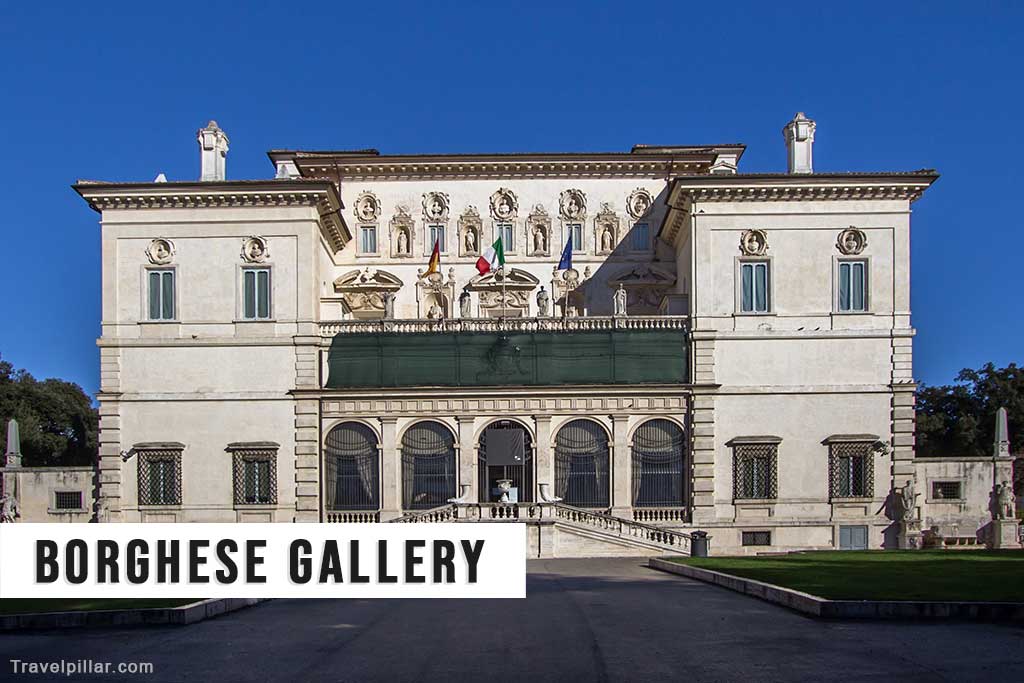
The Borghese Gallery and Museum, located in Villa Borghese Gardens, houses a prestigious collection of art. Built in the 17th century for Cardinal Scipione Borghese, it showcases masterpieces by Bernini, Caravaggio, Raphael, and Titian. Highlights include Bernini’s sculptures Apollo and Daphne and David, as well as Caravaggio’s Boy with a Basket of Fruit. The museum’s harmonious blend of art, architecture, and landscaped gardens makes it a cultural treasure.
Official tourism website:
https://galleriaborghese.cultura.gov.it/en/
Google map 4.6/5
#5 Galleria Doria Pamphilj

Galleria Doria Pamphilj is a private art gallery located in Rome’s Palazzo Doria Pamphilj. It houses an extensive collection of Renaissance and Baroque artworks, including masterpieces by Velázquez, Caravaggio, and Titian. The gallery is known for its opulent rooms and hallways, reflecting the grandeur of a noble Roman residence.
Google map 4.6/5
#6 Gallerie Nazionali Palazzo Barberini
The National Galleries of Ancient Art at Palazzo Barberini in Rome showcase a vast collection of Italian Renaissance and Baroque paintings. Housed in a 17th-century Baroque palace, the gallery features notable works by artists such as Caravaggio, Raphael, and Titian. Highlights include Caravaggio’s “Judith Beheading Holofernes” and the opulent “Triumph of Divine Providence” ceiling fresco by Pietro da Cortona.
Official website: https://barberinicorsini.org/
Google map 4.6/5
#7 Castel Sant’Angelo

Castel Sant’Angelo, also known as the Mausoleum of Hadrian, is a historic fortress in Rome located on the banks of the Tiber River. Originally built as a mausoleum for Emperor Hadrian in the 2nd century AD, it later served as a papal residence, fortress, and prison. Today, it functions as a museum, showcasing its varied history and offering panoramic views of the city from its terraces.
Official website: https://castelsantangelorome.com
Google map 4.7/5
#8 Palazzo Massimo alle Terme
Palazzo Massimo alle Terme is one of the four branches of the National Roman Museum. Located near Termini Station, it houses an extensive collection of classical art, including Roman frescoes, mosaics, coins, and sculptures. Highlights include the “Boxer at Rest” and the “Sleeping Hermaphroditus.” The museum provides insight into Roman daily life, aesthetics, and funerary practices, making it an essential stop for those interested in ancient Roman culture and craftsmanship.
Official website: https://museonazionaleromano.beniculturali.it/en/
Google map 4.6/5
#9 National Gallery of Modern and Contemporary Art
The National Gallery of Modern and Contemporary Art in Rome houses Italy’s largest collection of 19th- and 20th-century art. Located near Villa Borghese, it features works by Italian artists such as Giorgio de Chirico, Giacomo Balla, and Umberto Boccioni, alongside international figures including Monet, Klimt, and Pollock. The museum offers a broad overview of modern artistic movements and is organized thematically rather than chronologically to encourage varied interpretations.
Official website: https://gnamc.cultura.gov.it/en/
Google map 4.6/5
#10 Museo Nazionale Romano, Palazzo Altemps
Palazzo Altemps is one of the four locations of the Museo Nazionale Romano. Situated near Piazza Navona, it focuses on ancient sculpture, particularly Roman copies of Greek originals. The collection includes pieces from notable aristocratic families such as the Ludovisi. Exhibits are housed in a 15th-century Renaissance palace, combining classical art with historical architecture. The museum also explores themes of collecting and restoration practices in the history of classical antiquities.
Official website: https://museonazionaleromano.it/en/
Google map 4.6/5
#11 Museo Nazionale Romano, Terme di Diocleziano

The National Museum of Rome, housed in the ancient Baths of Diocletian, showcases a vast collection of artifacts spanning Roman history. Located near Termini Station, this museum highlights the grandeur of the Roman Empire through sculptures, inscriptions, and mosaics. The baths, constructed in 298 AD, were the largest of their kind and are partially preserved, offering insights into ancient engineering. The museum blends historical significance with cultural preservation in a monumental setting.
Official website: https://museonazionaleromano.it/en/
Google map 4.5/5
#12 Museum of Contemporary Art of Rome (MACRO)
The Museum of Contemporary Art of Rome (MACRO) is a leading institution dedicated to modern and contemporary art in Rome. Housed in a former brewery, the museum features a dynamic collection of Italian and international artworks from the 20th and 21st centuries. MACRO is known for its rotating exhibitions, innovative installations, and programs that engage with contemporary cultural issues.
Official website: https://www.museomacro.it
Google map 4.3/5