
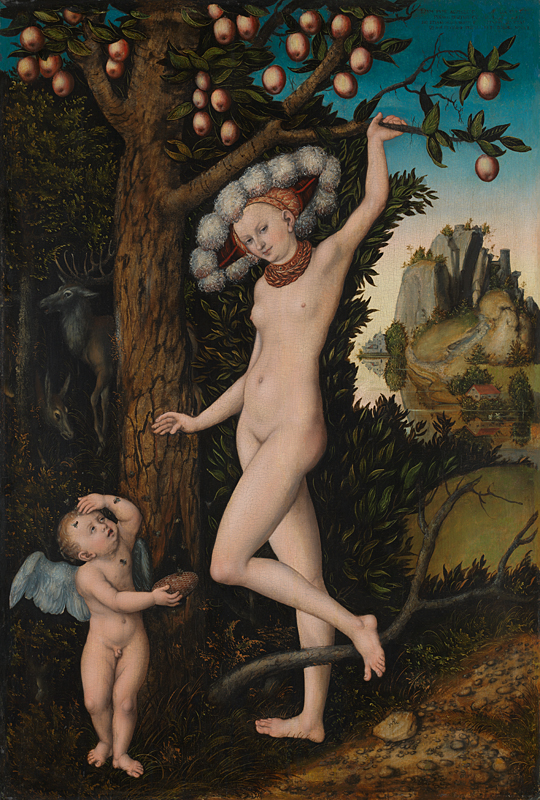
Cupid Complaining to Venus was painted by Lucas Cranach the Elder in the early sixteenth century and is now in the National Gallery, London. The subject comes from classical mythology but is treated with a moralising tone typical of Northern Renaissance art. The scene appears playful at first glance, yet it carries a pointed warning about desire and its consequences.
The painting shows the goddess Venus standing beside a tree heavy with fruit. At her feet, Cupid, her son and the god of love, cries in pain. According to the accompanying Latin inscription, Cupid has been stung by bees after stealing honey from a hive. He complains to his mother that something so small can cause such sharp suffering. Venus responds by explaining that love works in the same way: though it may seem sweet, it can bring unexpected pain.
The symbolism is direct. The honey represents pleasure — attractive, tempting, and easily desired. The bees’ sting stands for the hidden dangers that accompany indulgence. Cupid himself becomes a victim of the very force he represents. As the god whose arrows cause others to fall in love, he is now wounded by a similar paradox: sweetness paired with harm.
Cranach includes further symbolic detail in the landscape. The fruit-laden tree recalls the Garden of Eden and themes of temptation. The distant rocky terrain and castle suggest a wider world shaped by human choices. Venus appears calm and composed, detached from Cupid’s distress. She is less a nurturing mother and more an embodiment of beauty and desire itself — powerful but indifferent.
The painting was likely intended for a cultured court audience familiar with classical poetry. Its message would have been understood as a witty yet serious reflection on romantic passion. In the Renaissance, mythological subjects were often used to explore moral themes without overt religious imagery.
For modern viewers, Cupid Complaining to Venus remains accessible because its lesson is universal. Attraction promises sweetness, yet experience teaches caution. Cranach transforms a simple myth into a compact meditation on pleasure and consequence, reminding us that even the smallest indulgence can leave a lasting sting.
Weblink: https://www.nationalgallery.org.uk/