
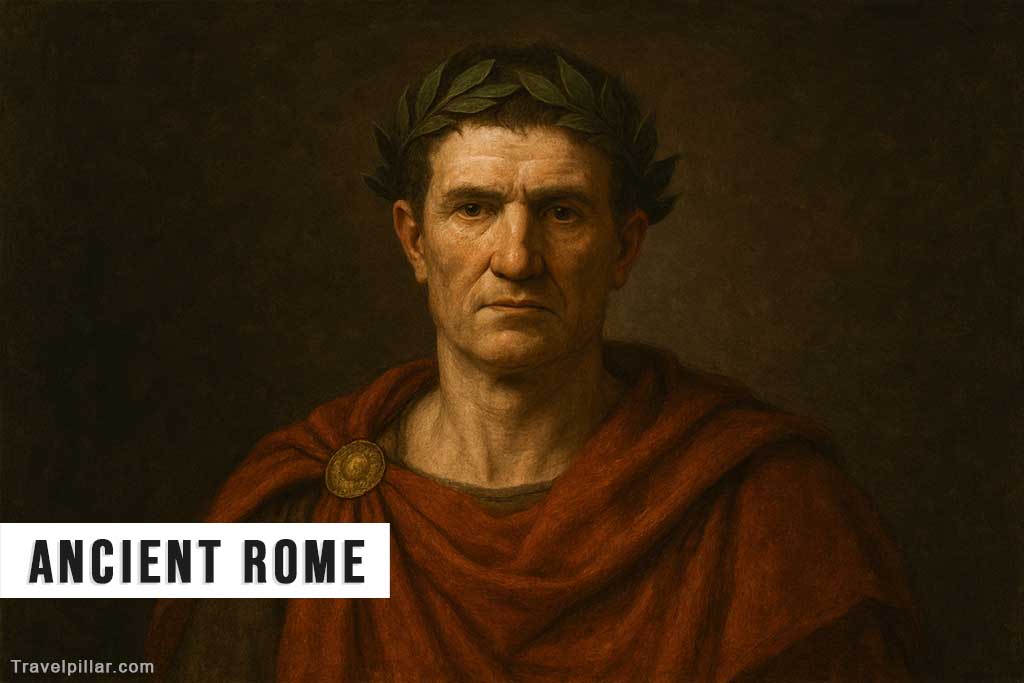
Ancient Rome was one of the most influential civilisations in world history, originating as a small settlement in central Italy during the 8th century BCE. It developed from a monarchy into a republic in 509 BCE and expanded through military conquest and strategic alliances to dominate the Mediterranean world. By the 1st century BCE, internal conflicts and power struggles led to the end of the Republic and the rise of the Roman Empire under Augustus in 27 BCE.
At its height, the Roman Empire extended from Britain in the northwest to Egypt in the southeast, incorporating diverse cultures and peoples under Roman governance. The empire was known for its administrative efficiency, legal systems, engineering, and urban planning. Its network of roads, aqueducts, and fortified towns facilitated communication, trade, and military movement across vast distances.
Roman society was hierarchical, with patricians, plebeians, and slaves forming its structure. Religion played a central role, incorporating a pantheon of gods and goddesses, later influenced by Greek deities. Public rituals, temples, and household worship reinforced cultural identity and state authority.
Rome’s architectural achievements remain visible today. Structures such as the Colosseum, built in the 1st century CE, hosted gladiatorial games and public spectacles. The Roman Forum served as the administrative and ceremonial centre, while monumental buildings like the Pantheon demonstrated advanced engineering with concrete construction and domed roofs. Roman baths, amphitheatres, and theatres were integral to urban life across the empire.
Latin, the language of Rome, formed the basis of Romance languages and influenced legal, scientific, and ecclesiastical terminology. Roman law, codified in texts such as the Twelve Tables and later the Corpus Juris Civilis under Justinian, provided a foundation for legal systems in Europe.
The decline of Rome began in the 3rd century CE, with political instability, economic challenges, and external invasions weakening imperial control. In 476 CE, the Western Roman Empire officially fell when the last emperor was deposed, though the Eastern Roman Empire, known as the Byzantine Empire, continued until 1453.
Today, the legacy of Ancient Rome is evident in European culture, architecture, law, and language. Visitors to Italy can explore extensive archaeological remains in Rome, including the Colosseum, Roman Forum, Palatine Hill, and Pantheon, gaining insight into the daily life, governance, and monumental achievements of this civilisation that shaped the foundations of Western society for centuries.