
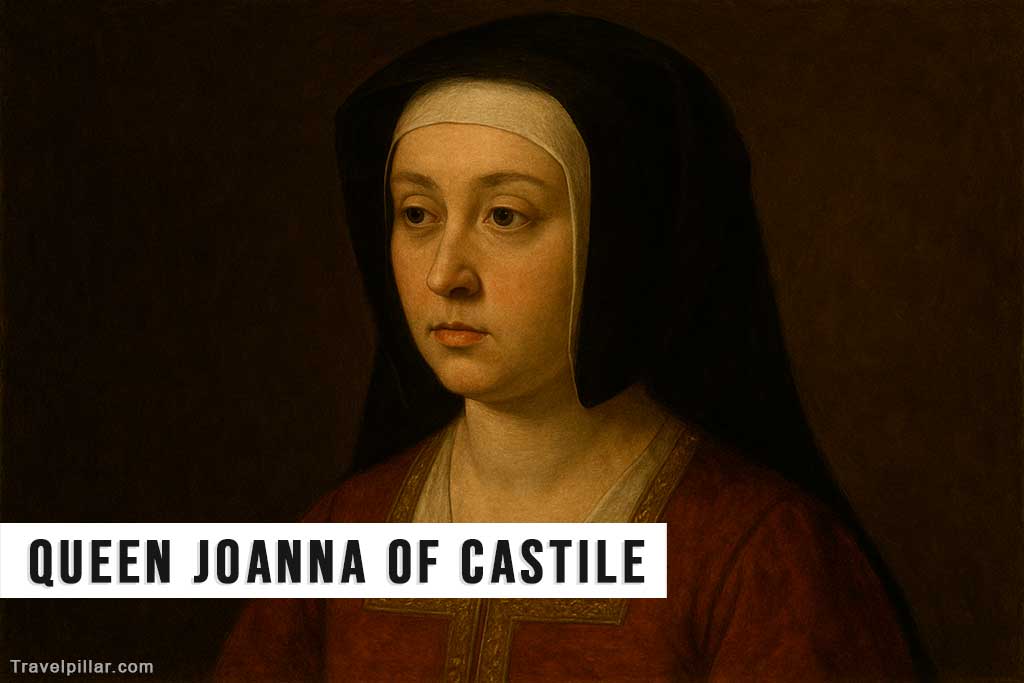
Queen Joanna of Castile, more commonly known as Joanna the Mad (1479–1555), was a key figure in the Spanish monarchy during a tumultuous period of political upheaval. Born to Ferdinand II of Aragon and Isabella I of Castile, Joanna was thrust into a role of significant political importance due to the matrimonial alliances of her parents that united Spain.
Joanna married Philip the Handsome, the Duke of Burgundy, in 1496, solidifying an alliance with the Habsburgs. This marriage produced six children who would become central figures in European politics, including Charles V who became the Holy Roman Emperor.
In 1504, Joanna became Queen of Castile upon the death of her mother. However, Joanna’s reign was marked by mental health issues, prompting speculation about her capacity to rule. Her husband Philip and father Ferdinand exploited her condition to their advantage, essentially ruling in her stead. After Philip’s death in 1506, Joanna’s father acted as regent until his death in 1516, after which her son Charles took over.
Joanna’s life was characterized by confinement and isolation. After Philip’s death, she was held in Tordesillas under a sort of house arrest, cut off from the affairs of the state. The tales of her roaming the halls with her husband’s coffin fueled the perception of her madness, a narrative propagated by those who profited from her incapacitation.
Her legacy is complex, shaped by the agendas of those around her and the demands of the era. While she is often remembered for her mental illness, she also played a pivotal role in the formation of modern Spain and the political landscape of 16th-century Europe. Joanna’s story serves as a testament to the intricate and often ruthless nature of royal politics, and her influence continues to echo in the annals of Spanish and European history.