
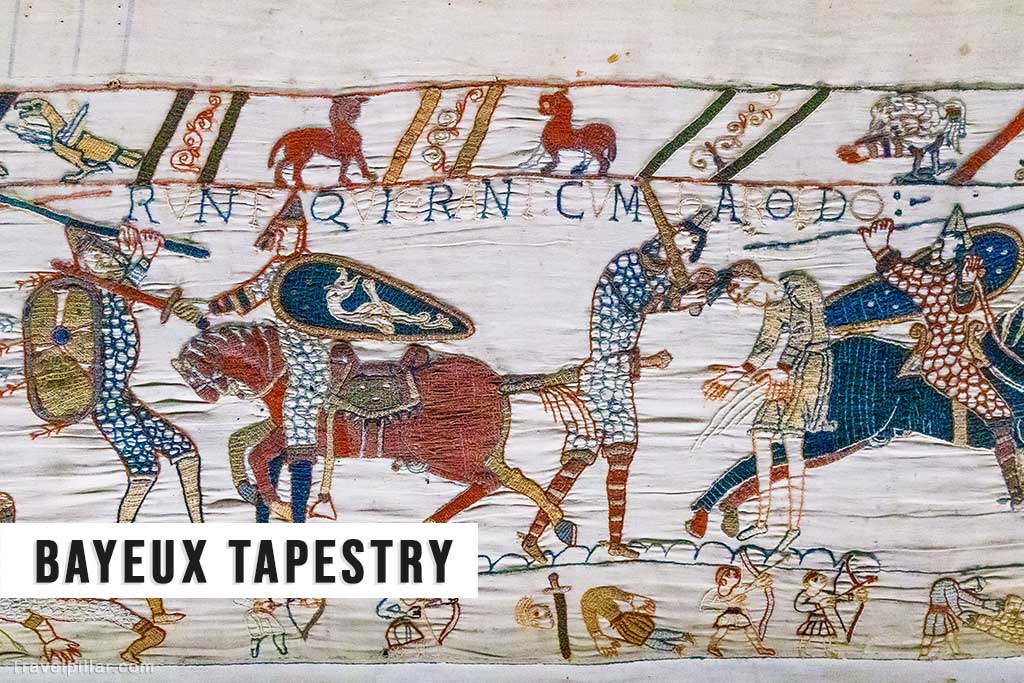
The Bayeux Tapestry is an extraordinary piece of medieval art that dates back to the 11th century. This 70-meter-long (230 feet) embroidered cloth narrates the events leading up to the Norman conquest of England in 1066, culminating in the famous Battle of Hastings. The tapestry is not only a significant work of art but also an invaluable historical document that provides insights into the political, social, and cultural aspects of the time.
Made from linen and embroidered with woolen yarns in eight different colors, the Bayeux Tapestry comprises 58 separate scenes, each depicting a particular event or incident. It features various characters, including King Edward the Confessor, Harold Godwinson, and Duke William of Normandy (aka William the Conqueror), as well as numerous soldiers, horses, ships, and buildings. The tapestry also includes Latin inscriptions, providing a written commentary on the unfolding narrative.
The exact origins of the Bayeux Tapestry remain uncertain, but it is widely believed to have been commissioned by Bishop Odo of Bayeux, half-brother of William the Conqueror. Despite being over 900 years old, the tapestry has been remarkably well-preserved and retains much of its original color and detail.
Today, the Bayeux Tapestry is on display at the Bayeux Museum in Bayeux, Normandy, France. It was listed on UNESCO’s “Memory of the World” register in 2007, acknowledging its outstanding universal value. The tapestry continues to attract scholars and tourists from around the globe, who marvel at its intricate craftsmanship and vivid portrayal of a defining moment in European history. The Bayeux Tapestry is not only an artistic masterpiece but also a vital source of information that helps us better understand the world of the 11th century and the events that shaped the future of England and France.
Google map Bayeux Tapestry Museum 4.6/5