
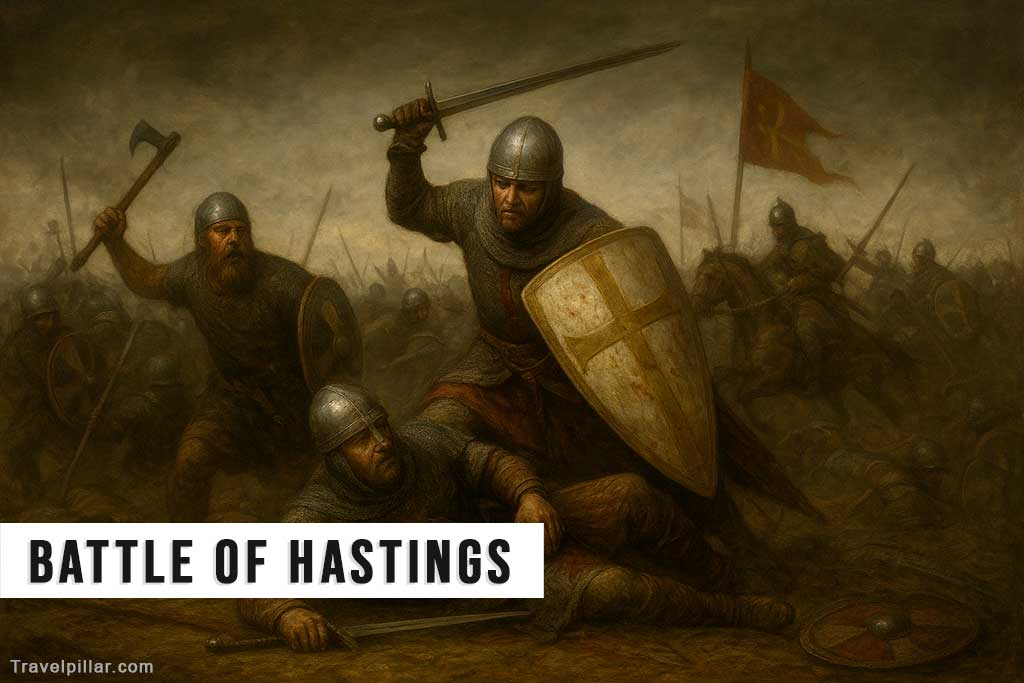
The Battle of Hastings, fought on October 14, 1066, was a crucial conflict that shaped the future of England. It took place near the town of Hastings, on a site now known as Battle, in East Sussex. The battle marked the decisive victory of William the Conqueror, Duke of Normandy, over King Harold II of England, resulting in the Norman conquest of England.
The battle arose from a dispute over the English throne following the death of King Edward the Confessor in January 1066. Edward had died without an heir, leading to claims by multiple contenders, including Harold Godwinson, who was crowned king, and William of Normandy, who argued that Edward had previously promised him the throne. Additionally, Harold had allegedly sworn an oath to support William’s claim, which added to the tension.
To enforce his claim, William assembled a fleet and a well-prepared army, crossing the English Channel in late September 1066. Harold, meanwhile, had just repelled a Norwegian invasion at the Battle of Stamford Bridge and was forced to rapidly march south to meet the Norman threat. This exhausting journey left his troops fatigued as they prepared to face William’s forces.
The battle took place on a ridge, where Harold’s army formed a defensive shield wall. William’s forces, composed of infantry, cavalry, and archers, attacked repeatedly but initially struggled to break through. The tide turned when the Normans used a feigned retreat tactic, tricking some of Harold’s troops into breaking formation. This strategy weakened the English defenses, allowing the Normans to penetrate the shield wall. By the end of the day, King Harold was killed, reportedly struck in the eye by an arrow, leading to the collapse of the English resistance.

William’s victory at Hastings resulted in the establishment of Norman rule in England. He was crowned King of England at Westminster Abbey on Christmas Day 1066, beginning a new era marked by significant changes in governance, land distribution, and cultural influence, including the introduction of Norman architecture and the feudal system.
Visitors interested in this pivotal moment in English history can explore the site of the battle, now home to Battle Abbey, which was built by William to commemorate his victory. The surrounding area, along with its visitor center and exhibits, provides a detailed look into the events of the battle and its lasting impact on England’s history.
The events of the battle are famously depicted in the Bayeux Tapestry, an 11th-century embroidered narrative over 70 metres long. It illustrates the political intrigue, military preparations, and combat scenes of 1066 in detail. Created in Norman-controlled England or Normandy, the tapestry is preserved today in Bayeux, France, and offers a unique visual record of the conquest from the Norman perspective.
Google map Battle Abbey 4.6/5
Google map Bayeux Tapestry Museum 4.6/5