
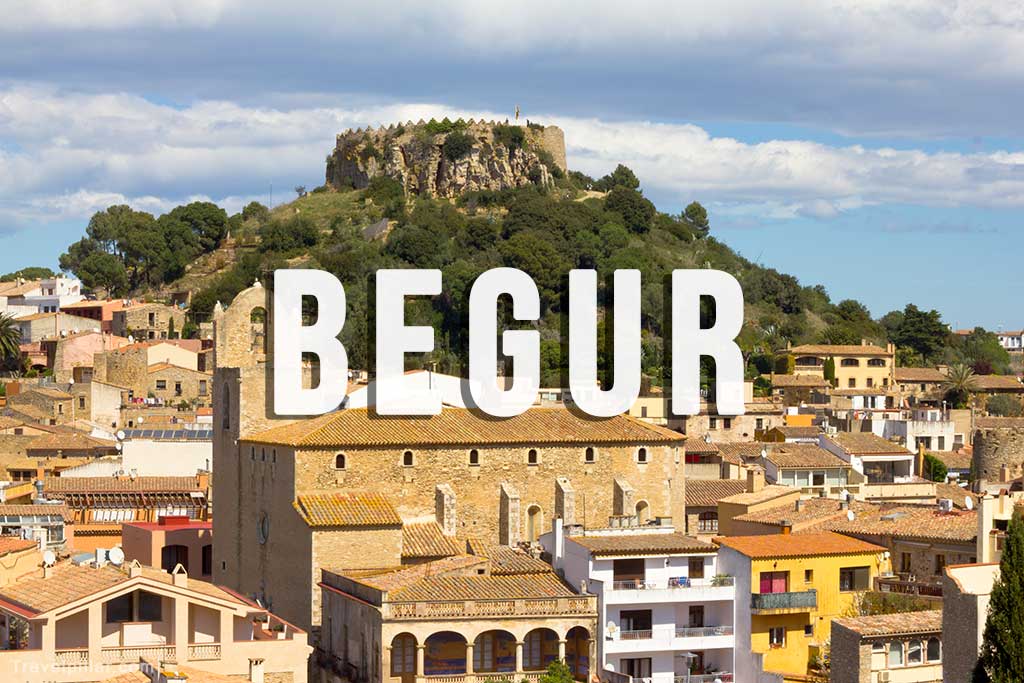
Begur is a hill town on the central Costa Brava in Catalonia, located slightly inland from the Mediterranean coast between Pals and Palafrugell. The town is known for its historic centre, coastal scenery and access to several of the Costa Brava’s best-known beaches and coves. Although relatively compact, Begur is regarded as one of the most attractive destinations in the region due to the combination of historic architecture, elevated views and nearby coastline.
The historic centre is built around narrow streets, small squares and stone buildings clustered beneath the remains of a medieval castle. The ruined castle occupies a hill above the town and provides wide views across the surrounding coastline, countryside and the Medes Islands. Defensive towers dating from the sixteenth century can also be seen around Begur, constructed during a period of pirate attacks along the Catalan coast.
During the nineteenth century, Begur developed commercial links with Cuba and other parts of the Caribbean through emigrants known locally as “Indians.” Several large colonial-style houses built by returning merchants remain visible in the town and contribute to its architectural character.
Much of Begur’s popularity comes from the coastline surrounding the town rather than the town centre itself. Nearby beaches and coves include Aiguablava Beach, Sa Tuna, Sa Riera and Platja Fonda. These beaches vary from sheltered sandy bays to smaller rocky coves and are connected in places by the Camí de Ronda coastal walking route. Pine woodland, cliffs and clear water characterise much of the surrounding coastline.
Begur is more upmarket and quieter in atmosphere than some of the larger Costa Brava resorts. While tourism is important during summer, the area remains focused more on scenery, beaches and walking routes than nightlife or large-scale resort development.
Official tourism website: https://visitbegur.cat/en/
Best things to do in Begur
Begur Castle (Castell de Begur)
The ruins of Begur Castle dominate the town from a hilltop. Dating to the 11th century, the fortress once protected the region from seaborne attacks. Though only fragments remain, the site offers panoramic views across the Costa Brava, including the Medes Islands. The castle provides historical context for Begur’s defensive past while serving as the town’s most recognisable landmark.
Google map 4.4/5
Begur Old Town
The old town of Begur is characterised by narrow streets, stone houses, and small squares. Architectural styles range from medieval buildings to 19th-century additions. Cafés, shops, and cultural events animate the centre while preserving its traditional appearance. The old town represents Begur’s layered history and provides the base from which to explore its coastal surroundings.
Google map Old Town 4.6/5
Google map Torre de Can Pella I Forgas 4.7/5
Cala Sa Tuna
Cala Sa Tuna is a small cove about 3km east from Begur’s centre. It retains the atmosphere of a fishing hamlet, with whitewashed houses lining the waterfront. The sheltered beach has clear waters suitable for swimming. Walking paths connect Sa Tuna to nearby headlands and other coves, illustrating the rugged coastal character that defines the Begur area.
Google map 4.6/5
Platja Fonda
Platja Fonda is a long, narrow beach accessible via a steep path. Its dark sand and high cliffs create a secluded atmosphere, in contrast to the busier beaches nearby. The lack of facilities preserves its natural character. Platja Fonda highlights the variety of landscapes along the Begur coastline, offering a quieter alternative within the same area.
Google map 4.6/5
Platja d’Aiguablava
Aiguablava is one of Begur’s most famous beaches, recognised for its turquoise waters and surrounding pine-covered cliffs. The sandy bay is accessible by road and has facilities for visitors. Its name, meaning “blue water,” reflects its setting. Aiguablava combines natural appeal with accessibility, making it one of the most visited coves of the Costa Brava.
Google map Aiguablav Beach 4.5/5
Fornells
Fornells is a coastal settlement near Aiguablava, developed around a small harbour. Its waterfront is lined with low houses and a few restaurants, maintaining a modest character. A 16th-century defensive tower reflects the historic need to guard against pirate raids. Fornells illustrates the link between Begur’s coastal hamlets and their maritime history.
Google map Fornells Beach 4.5/5
Cala Aiguafreda
Located northeast of Begur near Sa Tuna, Cala Aiguafreda is a small rocky inlet popular for snorkelling, diving and coastal walking rather than traditional sunbathing.
Google map 4.4/5
Platja de Sa Riera
Platja de Sa Riera is Begur’s largest beach, located in a wide bay north of the town. It has soft sand, calm waters, and visitor facilities, making it a popular choice for families. Despite its size, it retains sections that reflect its origins as a fishing settlement. Sa Riera demonstrates the balance between tourism development and traditional coastal heritage.
Google map Platja de Sa Riera 4.5/5
Platja de l’Illa Roja
Positioned between Begur and Pals, this sandy beach is recognised for its large reddish rock formation and relatively undeveloped surroundings. Parts of the beach are clothing optional.
Google map 4.6/5
Sant Pere Church (Església de Sant Pere de Begur)
The Church of Sant Pere, built in the 17th century, stands at the heart of Begur. Its plain stone façade contrasts with its baroque interior. The church remains an active place of worship and a reference point in the town. It reflects the religious traditions of Begur while contributing to the historic atmosphere of the old quarter.
Google map 4.2/5
Cami de Ronda
The Cami de Ronda coastal path passes through the Begur coastline, linking beaches and coves. Originally used by fishermen and customs officials, it now serves as a walking route with views over cliffs, pine forests, and bays. The section near Begur is considered one of the most scenic, illustrating the region’s rugged natural beauty.