
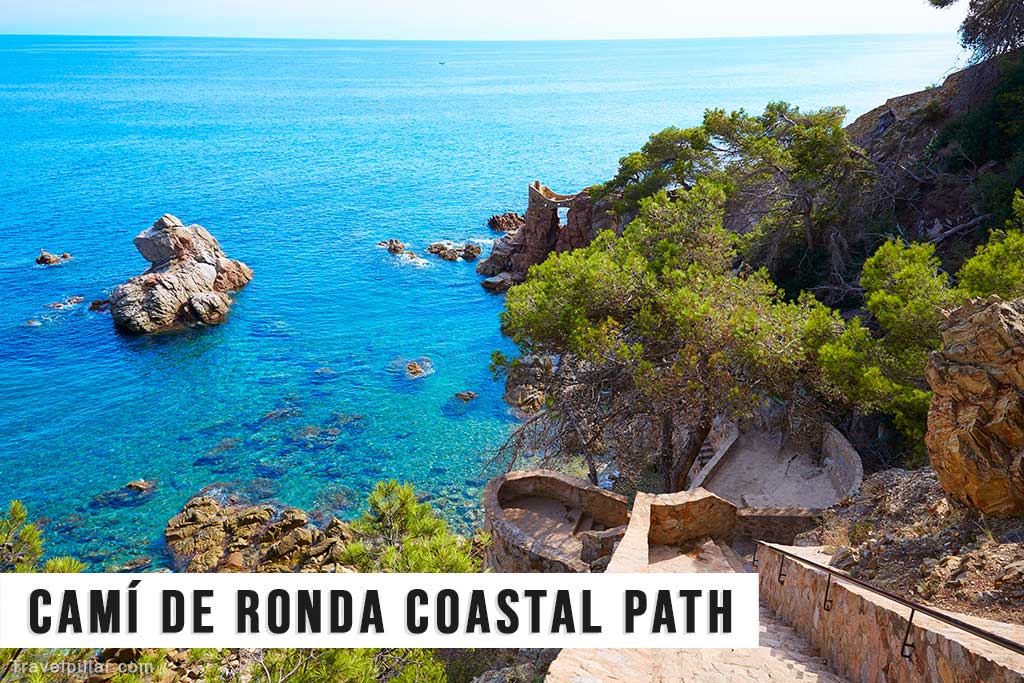
The Camí de Ronda (Camino de Ronda) is a long-distance footpath that traces much of the Costa Brava in Catalonia, Spain. Its origins lie in practical use rather than tourism. Fishermen, smugglers, and customs officers once relied on the route to move along the rugged coastline, monitor trade, and reach isolated coves. Today it has been repurposed as a walking trail that combines coastal scenery with cultural history.
The path runs for more than 200 kilometres between Blanes and Portbou, near the French border. While sections follow the shoreline closely, weaving around cliffs and rocky inlets, others move inland through pine forest, hills, and agricultural land. This variation reflects the geography of the region, where stretches of steep cliffs or private estates make direct coastal passage impractical. The result is a route that alternates between maritime views and rural landscapes.
Along the Camí de Ronda, walkers pass through many of the Costa Brava’s well-known towns and villages. These include Tossa de Mar, Begur, Calella de Palafrugell, Cadaqués, and Roses. Between them lie smaller coves and beaches accessible only by foot or boat, reinforcing the sense of discovery associated with the trail. Sections are marked and vary in difficulty, from gentle promenades near resorts to more demanding stretches of rocky terrain.
The Camí de Ronda also serves to illustrate the region’s broader identity. Its maritime associations recall the fishing and trading traditions that shaped the Costa Brava, while inland diversions highlight rural settlements and Mediterranean vegetation. Modern use reflects the growth of outdoor leisure and the preservation of natural heritage alongside tourism development.
As a continuous route, the Camí de Ronda offers the possibility of multi-day hikes, though many visitors choose shorter segments near particular towns. Whether explored in stages or as a whole, the path remains one of the most distinctive ways to experience the Costa Brava, linking natural geography, historical function, and modern recreation.
Useful websites
https://www.spain.info/en/
https://costabrava.org/ Route map and description pdf format
Top 10 Sections of the Camí de Ronda
The Camí de Ronda runs for over 200 kilometres along the Costa Brava, from Blanes to Portbou. Distances between sections vary, ranging from short village-to-village routes to full-day hikes. The following ten stretches are among the most recognised, combining accessibility with scenic and cultural value.
Blanes to Lloret de Mar (7 km)
This southernmost section links Marimurtra Botanical Garden in Blanes with Lloret’s urban beach. It combines cliffs, gardens, and sandy shoreline, offering an accessible introduction to the Costa Brava. The 7 km route is moderate in difficulty, taking about 2 hours.
Lloret de Mar to Tossa de Mar (12 km)
Crossing pine-covered headlands and coves such as Cala Canyelles, this section ends at Tossa’s medieval Vila Vella. At 12 km, it requires 3–4 hours and is moderately challenging. It demonstrates the shift from resort development to traditional heritage.
Tossa de Mar to Cala Pola (3 km)
A short but scenic 3 km path leads to Cala Pola. The route passes cliffs and viewpoints before reaching a sheltered cove. It takes under an hour, making it one of the most accessible and popular sections.
Sant Feliu de Guíxols to S’Agaró (6 km)
This landscaped section, designed in the early 20th century, features stone steps, balustrades, and gardens. The 6 km walk is easy, requiring about 1.5 hours. It is notable for its architectural detail and accessibility.
Calella de Palafrugell to Llafranc (1 km)
At only 1 km, this stretch is more of a seafront stroll than a hike. Linking two fishing villages, it passes coves and promenades. It can be walked in 15 minutes, but the cultural setting makes it significant.
Llafranc to Tamariu (6 km)
Climbing to the Sant Sebastià Lighthouse, this 6 km section offers panoramic views before descending to Tamariu. The route is moderately challenging and takes about 2 hours, alternating between cliffs, pine forest, and coves.
Begur to Sa Tuna and Aiguablava (8 km)
This section includes coves such as Sa Tuna and Aiguablava. It is 8 km and moderately difficult, requiring 2–3 hours. Narrow cliffside paths and rugged terrain make it one of the more striking parts of the route.
Palamós to Calella de Palafrugell (11 km)
Passing Platja de Castell and Iberian archaeological remains, this 11 km walk takes 3–4 hours. It combines undeveloped beaches with heritage sites, highlighting the natural and historical diversity of the Costa Brava.
Roses to Cap de Creus (15 km)
This longer section begins at Roses and heads toward Cap de Creus. At 15 km, it takes 5–6 hours and requires good fitness. The landscape becomes progressively wilder, with exposed cliffs and wind-shaped rocks.
Cadaqués to Portlligat and Cala Nans Lighthouse (6 km)
This 6 km section passes Dalí’s house in Portlligat and continues to Cala Nans Lighthouse. It takes around 2 hours and combines cultural heritage with rugged coastal scenery. Fishing coves and rocky inlets reinforce Cadaqués’ artistic and maritime identity.