
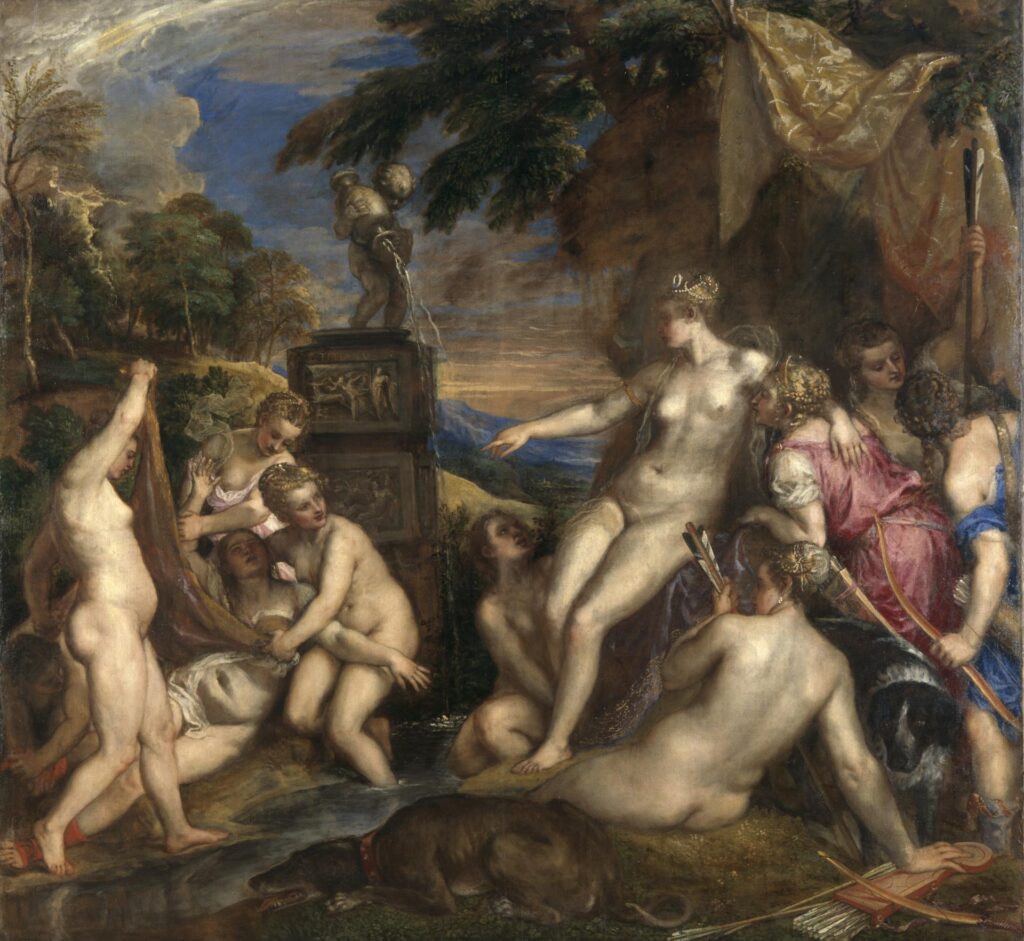
Diana and Callisto was painted by Titian between 1556 and 1559 and is now in the Scottish National Gallery, Edinburgh (jointly owned with the National Gallery, London). The painting illustrates a scene from Ovid’s Metamorphoses and captures the dramatic exposure of a secret that leads to exile and transformation.
The story centres on Callisto, a nymph and follower of Diana, goddess of the hunt (Artemis in Greek mythology). Diana demanded strict chastity from her companions. However, Callisto was seduced by Jupiter (Zeus), who disguised himself as Diana to approach her. When her pregnancy became visible, the truth was revealed during a bathing scene. Titian depicts the moment when Diana and the other nymphs discover Callisto’s condition.
The composition is charged with tension. Diana stands to the left, her posture firm and authoritative. She gestures toward Callisto, who is pulled forward and partially stripped by the other nymphs, exposing her pregnancy. Callisto’s expression conveys shame and distress. Her body curves defensively, contrasting with the assertive gestures around her. The nymphs form a ring of reaction — some surprised, others accusatory — amplifying the sense of collective judgement.
The landscape behind them is calm and luminous, creating a striking contrast with the emotional turmoil in the foreground. A small stream flows through the scene, symbolising purity, yet it also frames the moment of revelation. Titian balances beauty with cruelty. The figures are graceful and harmoniously arranged, yet the narrative is one of rejection and punishment.
According to the myth, Diana banishes Callisto. Later, Jupiter transforms her into a bear to protect her from further harm, and she is eventually placed in the sky as the constellation Ursa Major. The story therefore moves from humiliation to cosmic permanence, linking earthly suffering to celestial transformation.
For modern viewers, Diana and Callisto remains compelling because it explores themes of vulnerability, power, and injustice. Callisto is both victim and outcast, punished for a deception not entirely her own. Titian captures the precise instant when private truth becomes public shame. The painting invites reflection on loyalty, authority, and the consequences of desire within rigid social boundaries.