
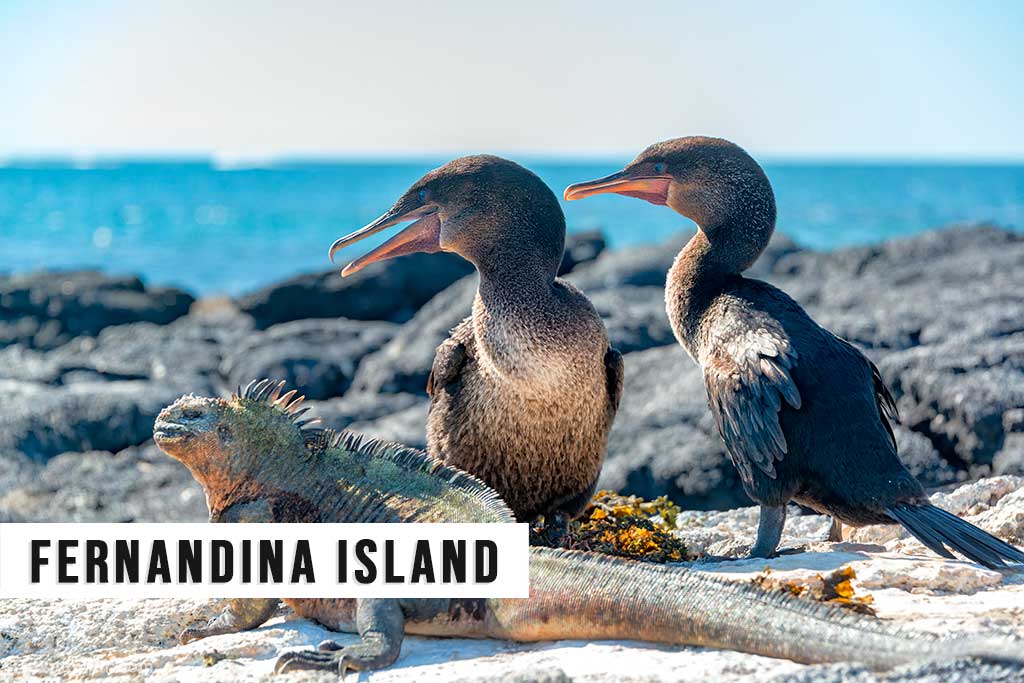
Fernandina Island, located on the western edge of the Galápagos archipelago, is the youngest and most volcanically active of the islands. It covers an area of approximately 642 square kilometers, making it the third largest in the chain. The island is dominated by La Cumbre, a shield volcano that rises to 1,476 meters and is frequently active, with eruptions recorded in recent decades. These eruptions shape the island’s stark landscape, consisting of fresh lava fields, fissures, and minimal vegetation, providing a clear view of geological processes in progress.
Due to its isolation and active geology, Fernandina has no introduced species and is considered one of the most pristine islands in the Galápagos. Its ecosystem is largely intact, offering a rare example of an environment free from human disturbance. Vegetation is sparse, limited mainly to pioneer plants such as mangroves and lava cacti, which colonize the new volcanic surfaces.
The main visitor site is Punta Espinosa, situated on the northeastern coast. This area is notable for its dense concentrations of marine iguanas, which can be seen basking on the black lava rocks. These iguanas feed in the surrounding waters and represent one of the largest populations in the islands. Flightless cormorants are another distinctive species found here. With their reduced wings and excellent diving ability, they are highly adapted to the marine environment. Galápagos penguins, sea lions, and Sally Lightfoot crabs are also common along the shores. Offshore waters, influenced by the nutrient-rich Cromwell Current, support a wide variety of marine life, making the surrounding seas an important feeding ground for whales and dolphins.
Access to Fernandina is tightly controlled by the Galápagos National Park, and visits are limited to guided groups. Landings are restricted to designated areas in order to protect the fragile environment. As the island has no human settlements, it remains a site of natural interest rather than habitation.
Fernandina Island offers a combination of active geology, intact ecosystems, and concentrated wildlife. Its volcanic features and species adapted to extreme conditions illustrate the processes that have shaped the Galápagos, making it a significant location for both scientific study and regulated tourism.
Google map 4.6/5