
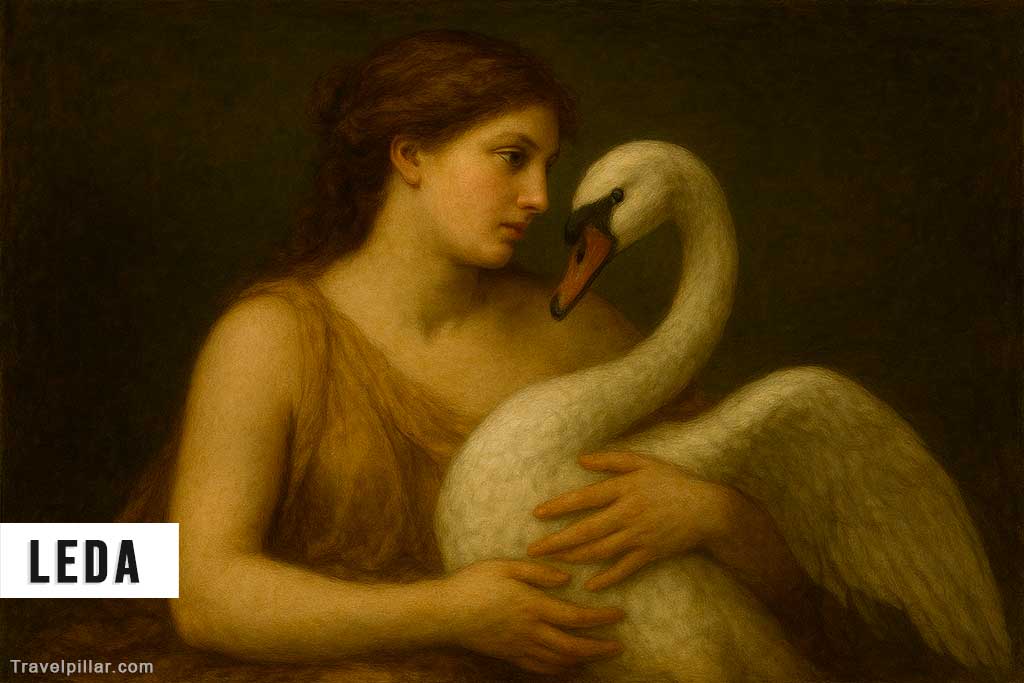
Leda, a prominent figure in Greek mythology, was the queen of Sparta and the wife of King Tyndareus. She is best known for her encounter with Zeus, which led to the birth of several significant mythological figures. According to myth, Zeus, the king of the gods, transformed into a swan to seduce or seek refuge with Leda. This union, along with her relationship with her mortal husband Tyndareus, resulted in the birth of four children: Helen of Troy, Clytemnestra, and the twin brothers Castor and Pollux, collectively known as the Dioscuri.

Leda’s myth is particularly famous for its connection to the Trojan War, as her daughter, Helen, became central to the conflict between Greece and Troy. Helen’s extraordinary beauty was said to have been the result of her divine parentage, as Zeus was her father. Clytemnestra, Leda’s other daughter, also played a significant role in Greek mythology, particularly in the story of Agamemnon, her husband, and her eventual involvement in his murder.
The twins, Castor and Pollux, were also pivotal figures in Greek mythology. Castor was mortal, being the son of Tyndareus, while Pollux was immortal, as Zeus was his father. They were renowned for their close bond and bravery, particularly in the stories of their adventures, such as their participation in the quest for the Golden Fleece. After Castor’s death, Pollux asked Zeus to share his immortality with his brother, and the twins were transformed into the constellation Gemini.
Leda’s myth has been a source of inspiration for numerous works of art and literature throughout history, with her story often focusing on themes of beauty, power, and divine influence. Visitors to Sparta, the legendary city-state where Leda ruled as queen, can explore ancient ruins and sites connected to the mythological heritage of the region. Leda’s legacy in Greek mythology is closely tied to the figures of Helen, Castor, and Pollux, and her story continues to resonate in the wider context of Greek mythological traditions.