
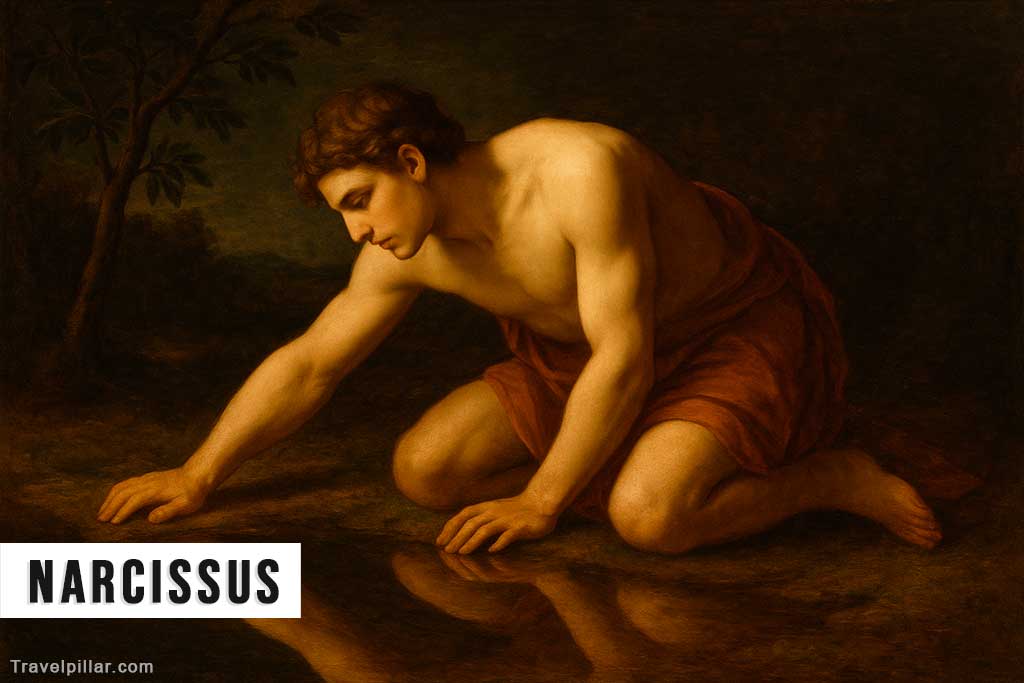
Narcissus, a well-known figure in Greek mythology, was a hunter celebrated for his extraordinary beauty. He was the son of the river god Cephissus and the nymph Liriope. Narcissus’s story revolves around themes of vanity, self-love, and the consequences of excessive pride. He was admired by many for his striking appearance, but his arrogance and indifference toward others’ affections led to his downfall.
The most famous version of the myth involves the mountain nymph Echo, who fell in love with Narcissus. However, Narcissus spurned her love, and in her grief, Echo faded away until only her voice remained. As punishment for his cruelty, Nemesis, the goddess of retribution, caused Narcissus to fall in love with his own reflection. While drinking from a pool, Narcissus saw his reflection in the water and became so entranced by his own image that he could not look away. He eventually wasted away, either drowning or dying of thirst, depending on the version of the myth. In some versions, after his death, a flower, the narcissus, sprang up where he had been, symbolizing his transformation.
Narcissus’s story is often interpreted as a cautionary tale about the dangers of vanity and excessive self-obsession. The myth highlights the ancient Greek values of humility and respect for others, warning against pride and arrogance. His name has also given rise to the modern term “narcissism,” which refers to excessive self-love and selfishness.
Visitors to Greece can explore sites associated with the myths and characters of ancient Greece. Although Narcissus himself is not tied to specific locations, the region of Boeotia, where his myth is believed to have originated, offers historical significance and connection to other legendary figures of Greek mythology. Additionally, museums throughout Greece, such as the National Archaeological Museum in Athens, house depictions of Narcissus in art and sculpture, offering further insights into the myth and its impact on Greek culture.
Narcissus remains a lasting symbol in mythology, embodying the complexities of human behavior and the consequences of self-centeredness.