
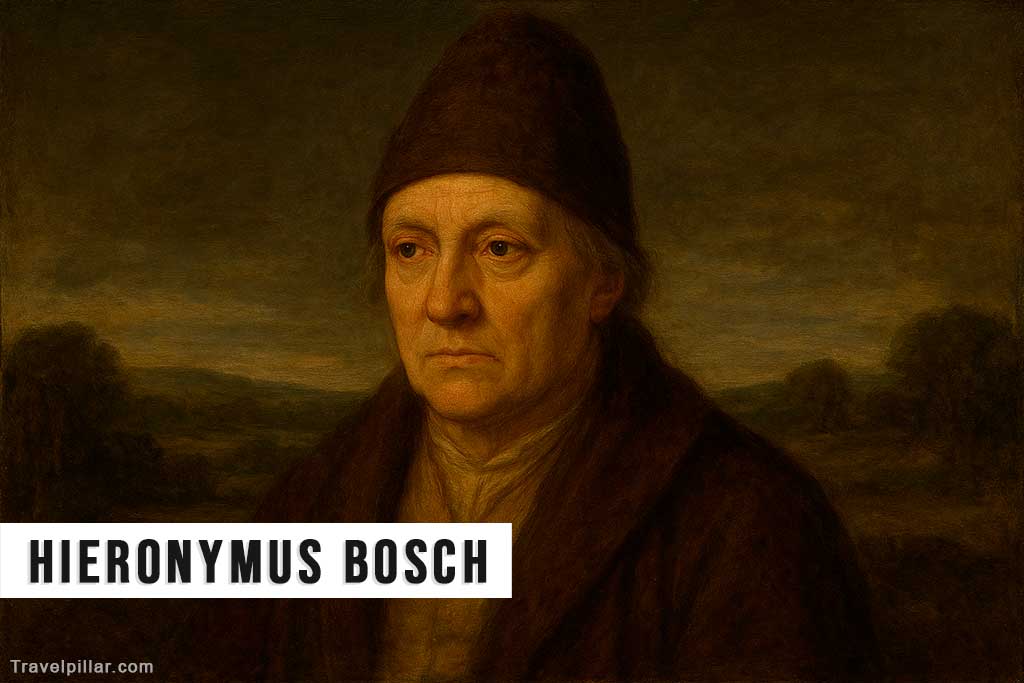
Hieronymus Bosch (1450-1516), born Jheronimus van Aken, was a Dutch painter renowned for his detailed, fantastical, and often macabre works. A significant figure in the Early Netherlandish painting tradition, Bosch spent most of his life in ‘s-Hertogenbosch, from which he adopted his name.
Bosch’s work is characterized by its use of vivid imagery to portray moral and religious concepts and narratives. He is best known for his triptychs — three-panel paintings that can be folded shut. These works, including his most famous, “The Garden of Earthly Delights,” are filled with symbolic, often surreal, and sometimes grotesque scenes, featuring an array of monstrous creatures and distorted figures.
His innovative approach to the representation of hell and sin was groundbreaking. Unlike his contemporaries, who often depicted these concepts metaphorically, Bosch portrayed them in literal and highly imaginative ways. His complex, enigmatic works, which were often rich with symbolism, continue to inspire differing interpretations among art historians.
Not much is known about Bosch’s life, which adds to the enigma surrounding his work. He was a member of the Brotherhood of Our Lady, a prestigious religious group of ‘s-Hertogenbosch, which suggests he was a respected figure in his community.
Despite the lack of records about Bosch’s life and career, his influence on art history is undeniable. His imaginative iconography had a significant impact on the development of the fantastic and the grotesque in art, influencing later artists like Pieter Bruegel the Elder.
Bosch’s enduring influence is a testament to his unique artistic vision. His work continues to captivate audiences with its originality, complexity, and its deeply engaging exploration of human virtues and vices. His contribution to the tradition of Northern Renaissance art marks him as one of the most significant artists of his time.