
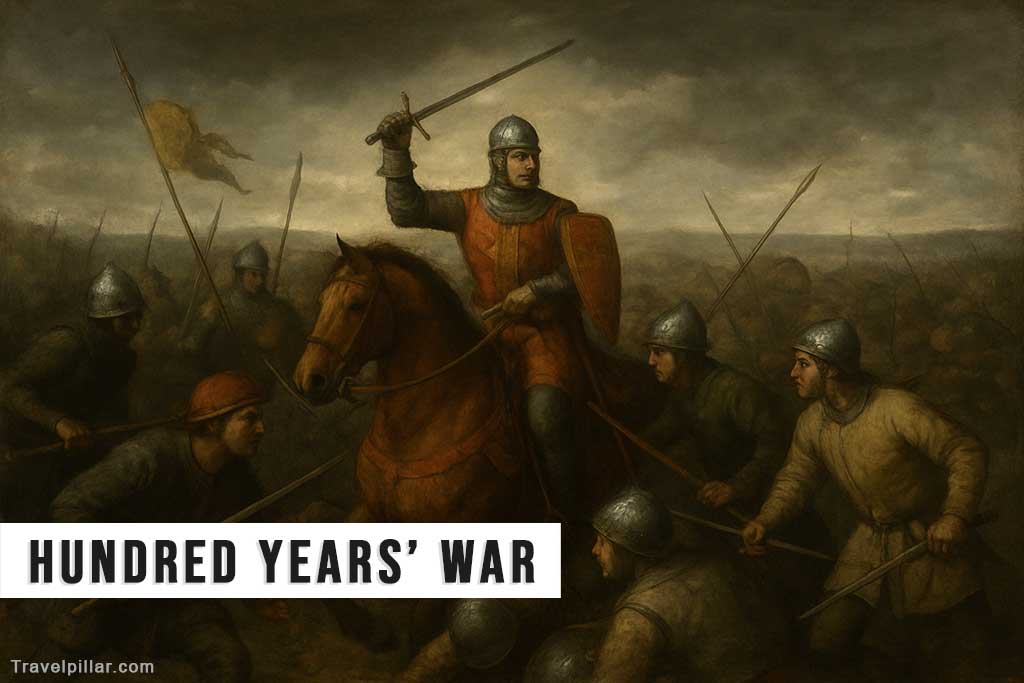
The Hundred Years’ War (1337–1453) was a prolonged series of conflicts between the Kingdom of England and the Kingdom of France, primarily over territorial disputes and claims to the French throne. Spanning 116 years, the war significantly influenced medieval Europe, shaping the development of national identities and altering the balance of power across the continent.
The origins of the conflict lie in the complex feudal relationships between England and France. The English monarchy controlled territories in France, including Aquitaine, creating tension with the French crown. When Charles IV of France died in 1328 without a male heir, Edward III of England, the son of Charles’ sister Isabella, claimed the French throne. This was contested by Philip VI of France, leading to the outbreak of war.
The war is typically divided into three phases: the Edwardian War (1337–1360), the Caroline War (1369–1389), and the Lancastrian War (1415–1453). Each phase was marked by shifting alliances, key battles, and intermittent periods of peace. Notable conflicts include the Battle of Crécy (1346), where the English longbow demonstrated its effectiveness, and the Battle of Agincourt (1415), a decisive English victory under Henry V.
Despite early English successes, the tide turned in favor of the French, particularly with the rise of Joan of Arc. Her role in lifting the Siege of Orléans in 1429 reinvigorated French morale and marked a turning point. By 1453, the French, under Charles VII, had regained nearly all territories except Calais, ending English ambitions on the continent.
The Hundred Years’ War had profound consequences. It contributed to the decline of feudalism, as the war required centralized taxation and standing armies. Advances in military technology, such as the use of gunpowder, signaled the end of traditional medieval warfare. Economically, the conflict strained resources on both sides but also stimulated trade and development in some regions.
For travelers interested in history, the sites associated with the war offer insights into this transformative period. Castles like Château de Beynac and battlefields such as Agincourt provide tangible connections to the conflict, allowing visitors to explore the legacy of this defining chapter in European history.