
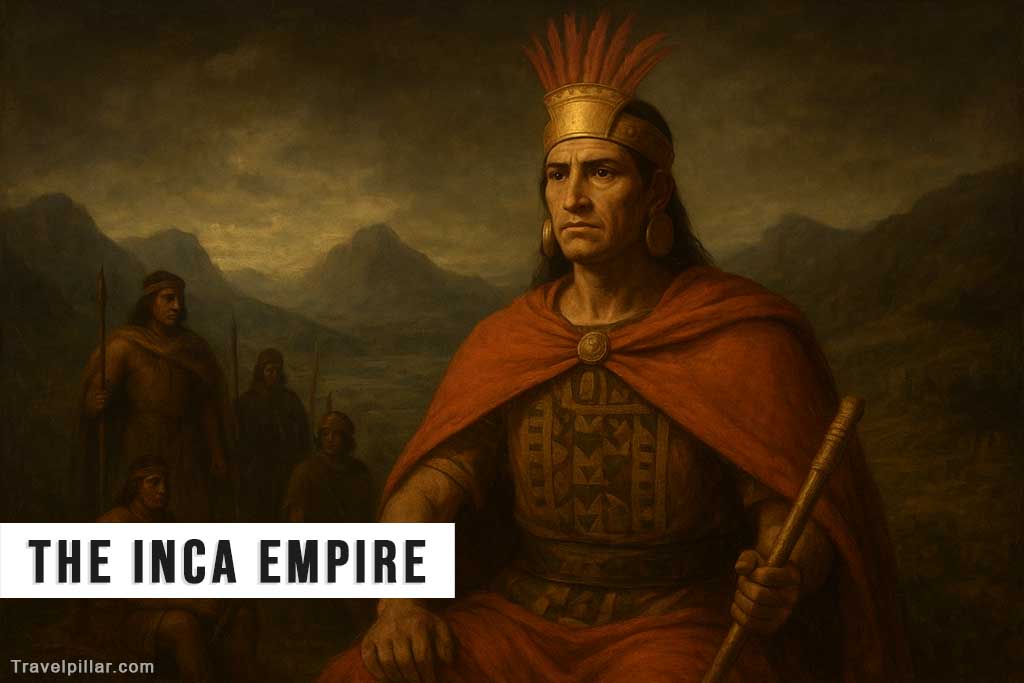
The Inca Empire, also known as the Incan Empire and the Inka Empire, was the largest empire in pre-Columbian America. It emerged in the region of modern-day Peru in the early 13th century, and its political and administrative structure came into existence under the leadership of Pachacuti Inca Yupanqui in the mid-15th century. The empire spanned a vast territory that included significant portions of modern-day Peru, western Ecuador, western and south-central Bolivia, northwest Argentina, north and central Chile, and southern Colombia.
Political Structure and Economy
The Inca Empire was a centralized society ruled by a single leader, known as the Sapa Inca, who was often regarded as a deity. The empire had a complex political and administrative structure, with various levels of authority and a bureaucracy overseeing sectors like agriculture, labor, and taxation.
The Incas had a command economy, in which production and the distribution of commodities were controlled by the state. This system allowed the rulers to mobilize labor on a massive scale and facilitated the construction of monumental architecture, terracing, roads, and bridges.
Roads and Communication
One of the remarkable achievements of the Inca Empire was the construction of an extensive road network, which extended over 25,000 miles. The roads connected various parts of the empire, facilitating trade, military movement, and administrative control. Chasquis, or relay runners, used these roads to deliver messages and goods across the empire, showcasing a sophisticated communication system.
Religion and Culture
Incan religion was polytheistic, and it involved the worship of natural elements like the sun, moon, and earth. The Sapa Inca was considered the “Son of the Sun.” Rituals and ceremonies were an integral part of Inca religion, and they built impressive temples for worship, the most famous of which is Machu Picchu, a royal estate and religious retreat.
In terms of language, the Inca spoke Quechua, which is still spoken today in parts of Peru, Bolivia, and Ecuador. Despite their lack of a written language, the Inca used a system of knotted strings known as quipu to record information, including census data and tax obligations.
Decline
The fall of the Inca Empire began with the Spanish conquest led by Francisco Pizarro in the 16th century. The empire was already weakened by a civil war between two sons of the Sapa Inca, Huayna Capac – Atahualpa and Huáscar. In 1532, Atahualpa was captured during the Battle of Cajamarca, and in 1533 he was executed, marking the end of the Inca Empire. Despite this, resistance to Spanish rule continued in parts of the empire until the late 16th century.
Legacy
Despite its relatively short existence, the Inca Empire left a significant architectural and cultural legacy. Structures like Machu Picchu, Sacsayhuamán, and the city of Cusco stand testament to Inca engineering skills. Similarly, their achievements in agriculture, especially the cultivation of potatoes and maize, and their practices of terrace farming continue to influence Andean societies. The Quechua language, music, folklore, and certain aspects of social organization are also enduring aspects of the Inca’s cultural legacy.