
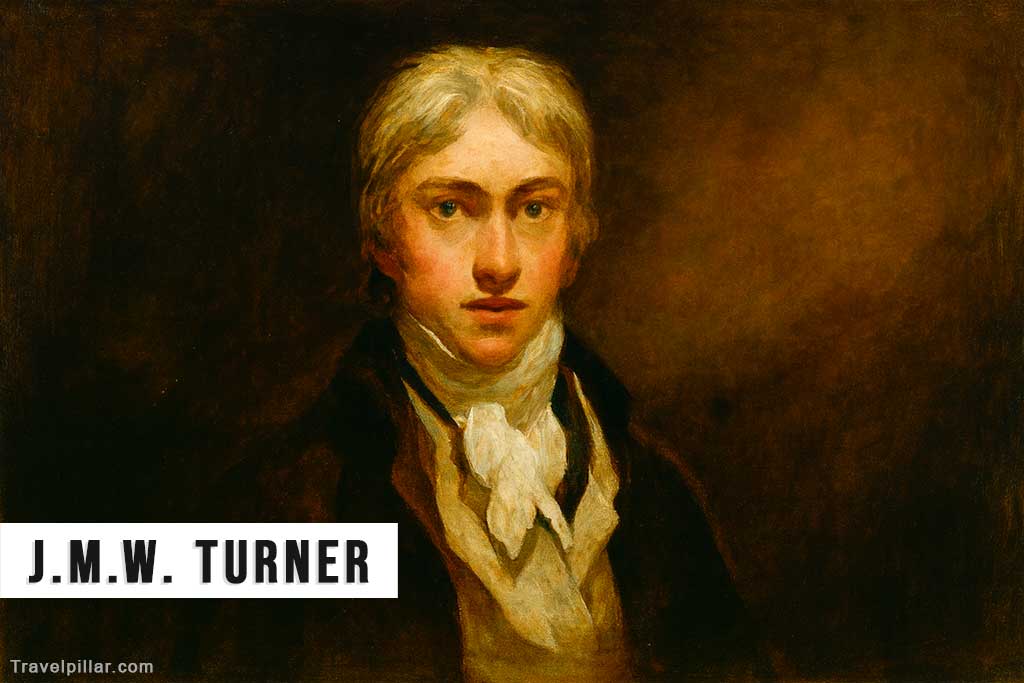
Joseph Mallord William Turner (1775-1851), commonly known as J.M.W. Turner, was an English painter and printmaker recognized for his mastery in capturing light, color, and atmospheric effects in his works. His innovative techniques and stylistic advancements significantly influenced the Impressionist movement and shaped the course of modern art.

Born in London, Turner showed an early interest in art and entered the Royal Academy of Art school at just 14 years old. He first gained recognition for his watercolor landscapes, but soon moved on to oil paintings, working within a classical framework before developing a distinct style that pushed the boundaries of visual representation.

Turner’s body of work, particularly his landscapes and marine paintings such as “The Fighting Temeraire” and “Rain, Steam, and Speed – The Great Western Railway,” are noted for their vibrant palettes, fluid depiction of light, and near-abstract quality. The latter part of his career saw his style evolve to emphasize the atmospheric effects and elemental forces in his scenes, often at the expense of solid forms.

Often referred to as the “painter of light,” Turner’s innovative exploration of the luminous and expressive potential of color prefigured the techniques of the Impressionists and contributed to the onset of abstract art. His work moved away from the detailed precision of the early 19th-century style towards a focus on color, light, and atmospheric effect.
Turner was a controversial figure during his lifetime, with his later works often met with harsh criticism due to their radical departure from traditional artistic conventions. Despite this, he left a lasting legacy on the art world, pushing the boundaries of what was deemed acceptable in art and what art could aspire to express.
Today, J.M.W. Turner is celebrated as a forerunner of modernism, his innovative techniques and stylistic exploration marking a turning point in the history of art.