

Karl Marx was a German philosopher, economist, historian and political theorist whose ideas transformed political thought and had a profound influence on world history. Although he never held political office or led a revolution, his writings inspired communist movements across the globe and provided the intellectual foundations for the Soviet Union, the People’s Republic of China and many other communist states during the 20th century.
Marx believed that society was shaped by economic forces and that history was driven by conflict between different social classes. His analysis of capitalism, industrialisation and inequality remains widely studied today, and his ideas continue to influence politics, economics and sociology.
For travellers, Marx’s legacy can be explored through museums, monuments and historic sites across Europe. From his birthplace in Germany to the cities where he lived and worked, these places help tell the story of one of history’s most influential thinkers.
Early Life
Karl Heinrich Marx was born on 5 May 1818 in Trier, in what is now western Germany. He grew up in a well-educated middle-class family and studied law and philosophy at the Universities of Bonn and Berlin. While at university, he became increasingly interested in philosophy, politics and economics, particularly the social changes brought about by the Industrial Revolution.
After completing his studies, Marx worked as a journalist, where he criticised government policies and social inequality. His political writings attracted the attention of the authorities, forcing him to leave Germany and live in exile for much of his life.
Partnership with Friedrich Engels
One of the most important relationships in Marx’s life was his friendship with Friedrich Engels, the son of a wealthy textile manufacturer. Although they came from very different backgrounds, the two men shared an interest in improving the lives of industrial workers.
Engels provided both intellectual collaboration and financial support, allowing Marx to continue his research and writing despite frequent financial hardship. Together they developed many of the ideas that became the basis of modern communist theory.
The Communist Manifesto
In 1848, Marx and Engels published The Communist Manifesto, one of the most influential political documents ever written.
The manifesto argued that history was shaped by struggles between social classes and predicted that workers would eventually overthrow capitalist societies and establish a classless system based on common ownership of the means of production. Although relatively short, the document has been translated into hundreds of languages and continues to be studied throughout the world.
While the manifesto attracted attention at the time, many of Marx’s ideas gained much greater influence after his death.
Das Kapital
Marx spent many years researching and writing Das Kapital, his major work on economics and capitalism. The first volume was published in 1867, with later volumes edited and published by Engels after Marx’s death.
In Das Kapital, Marx examined how capitalist economies functioned, arguing that competition, profit and private ownership created inequalities between employers and workers. Whether readers agree with his conclusions or not, the book remains one of the most influential works ever written on economics and political theory.
Marx’s Influence on World History
Karl Marx died in London on 14 March 1883, long before any country adopted a communist system of government. However, his ideas became increasingly influential during the early 20th century.
Following the Russian Revolution of 1917, Vladimir Lenin adapted many of Marx’s theories to establish the world’s first communist state. Later, communist governments came to power in countries including China, Cuba, Vietnam and several nations in Eastern Europe.
Not all communist governments interpreted Marx’s ideas in the same way, and historians continue to debate the extent to which these states reflected Marx’s original writings.
Places Connected with Karl Marx
Several places associated with Karl Marx can still be visited today.
His birthplace in Trier has been preserved as the Karl Marx House Museum, where visitors can learn about his life and writings through exhibitions and original artefacts.
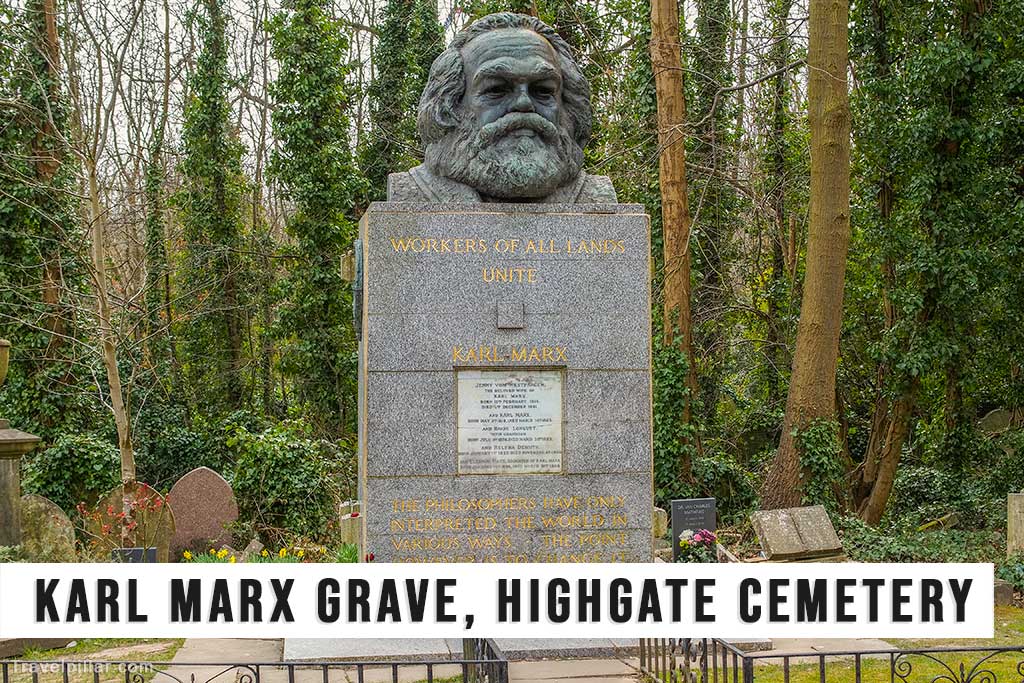
Marx spent much of his adult life in London, where he carried out research in the Reading Room of the British Museum while writing Das Kapital. He is buried in Highgate Cemetery, where his large memorial has become a place of pilgrimage for visitors interested in political history.
These sites provide valuable insight into the life of a thinker whose ideas influenced the course of modern history.
Karl Marx’s Legacy
Few philosophers have had a greater impact on the modern world than Karl Marx. His ideas influenced revolutions, governments and political movements across several continents, while also shaping the study of economics, sociology, history and political science.
His legacy remains both significant and controversial. Supporters argue that his work highlighted the problems of inequality and exploitation during the Industrial Revolution, while critics believe that governments inspired by his ideas often became authoritarian and failed to achieve the classless societies they envisioned.
For travellers, learning about Karl Marx provides a deeper understanding of many of the museums, monuments and historic sites associated with communism, the Russian Revolution and the Cold War, offering important context for some of the most significant events of modern history.