
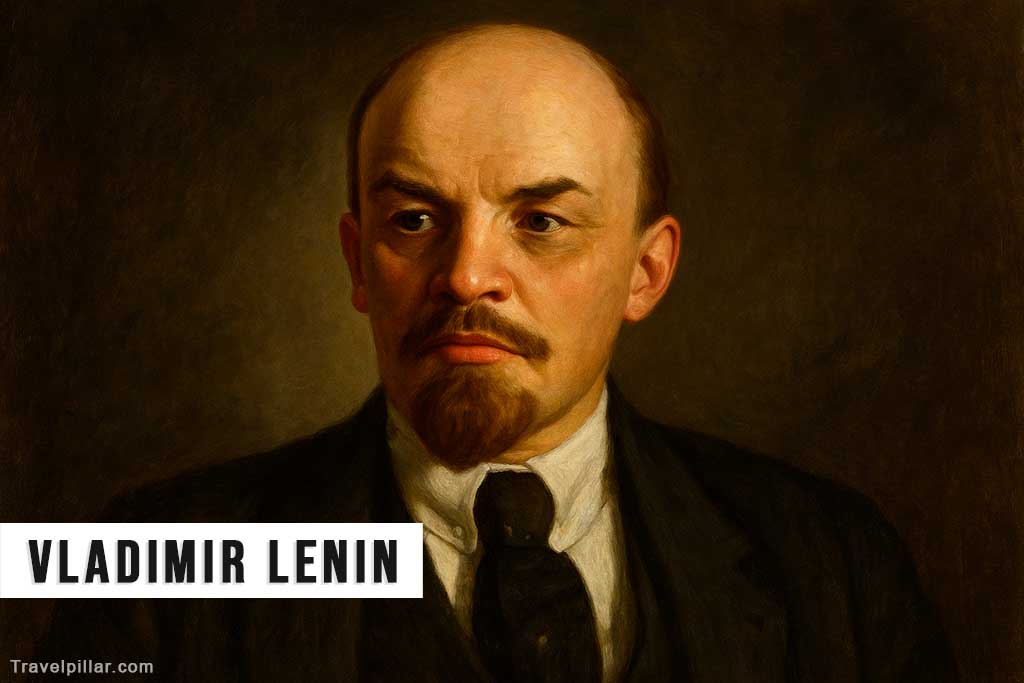
Vladimir Lenin was a Russian revolutionary, political theorist and the founder of the Soviet Union. He led the Bolshevik Revolution of 1917, overthrew Russia’s Provisional Government and became the country’s first communist leader. His ideas and leadership transformed Russia and influenced politics around the world for much of the 20th century.
Although Lenin ruled for only a few years, his impact was enormous. He helped establish a new political system based on the principles of Karl Marx, withdrew Russia from the First World War and laid the foundations of the Soviet state. Today, his legacy remains both significant and controversial, with some viewing him as a champion of social change and others criticising the authoritarian methods used during his government.
For travellers, Lenin’s influence can still be seen across Russia and many former Soviet republics through monuments, museums, preserved buildings and public squares that reflect one of the most important periods in modern history.
Early Life
Vladimir Ilyich Ulyanov was born on 22 April 1870 in Simbirsk, a city on the Volga River that is now called Ulyanovsk in his honour. His family was relatively well educated, and he excelled at school.
A defining moment came in 1887 when his older brother, Alexander, was executed for participating in a plot to assassinate Tsar Alexander III. The event deeply affected Lenin and contributed to his growing interest in revolutionary politics.
After studying law, Lenin became involved with Marxist groups that opposed the Russian monarchy. His political activities led to repeated arrests, imprisonment and exile in Siberia before he spent many years living elsewhere in Europe, where he continued writing and organising revolutionary movements.
The Bolshevik Revolution
The outbreak of the First World War placed enormous strain on Russia, leading to economic hardship, military defeats and growing unrest. After Tsar Nicholas II abdicated during the February Revolution of 1917, a Provisional Government took control but struggled to address the country’s problems.
Lenin returned to Russia in April 1917 and argued that power should be transferred to workers’ councils, known as Soviets. His slogan of “Peace, Land and Bread” attracted widespread support among soldiers, workers and peasants who wanted an end to the war and improvements to their living conditions.
In October 1917, the Bolsheviks seized control of Petrograd, now St Petersburg, and overthrew the Provisional Government. Lenin became the head of the new Soviet government, beginning a new chapter in Russian history.
Leader of Soviet Russia
One of Lenin’s first decisions was to withdraw Russia from the First World War by signing the Treaty of Brest-Litovsk with Germany in 1918. Although the treaty required Russia to surrender large areas of territory, it fulfilled his promise to end the country’s involvement in the conflict.
Lenin’s government also nationalised banks, major industries and large estates while introducing sweeping political and economic reforms. During the Russian Civil War, the Bolsheviks faced fierce opposition from anti-communist forces, and the government adopted increasingly harsh measures to maintain control.
The creation of the secret police, political censorship and the suppression of opposition became defining features of Lenin’s rule. Historians continue to debate the extent to which these policies shaped the later development of the Soviet state.
The Creation of the Soviet Union
In 1922, Russia joined several neighbouring republics to form the Union of Soviet Socialist Republics (USSR), commonly known as the Soviet Union. Lenin became its first leader and played a central role in designing the structure of the new state.
By this time, however, his health had begun to deteriorate following a series of strokes. Before his death, Lenin expressed concerns about the growing influence of Joseph Stalin and questioned whether he should become the country’s future leader. These warnings were largely ignored after Lenin’s death.
Lenin died on 21 January 1924 at the age of 53.
Lenin’s Mausoleum
Following his death, Lenin’s body was embalmed and placed in a specially constructed mausoleum on Red Square in Moscow. The mausoleum quickly became one of the Soviet Union’s most important political symbols, attracting visitors from across the country and around the world.
Today, Lenin’s Mausoleum remains open to the public and continues to be one of Moscow’s most visited historical sites. Nearby are the Kremlin and Red Square, two locations closely associated with both Imperial Russia and the Soviet era.
Lenin’s Legacy
Few political leaders have had a greater influence on modern history than Vladimir Lenin. His leadership during the Russian Revolution led to the establishment of the world’s first communist state, while his interpretation of Marxism shaped governments and political movements across much of the 20th century.
His legacy remains complex. Supporters credit him with transforming Russia, promoting education and creating a new political system based on socialist ideals. Critics point to political repression, restrictions on freedom and the authoritarian foundations established during his rule.
For travellers, Lenin’s story provides valuable insight into Russia’s revolutionary past. Museums, monuments, former government buildings and preserved Soviet landmarks throughout Russia offer opportunities to explore the life of a man whose influence continues to be felt long after the collapse of the Soviet Union.