
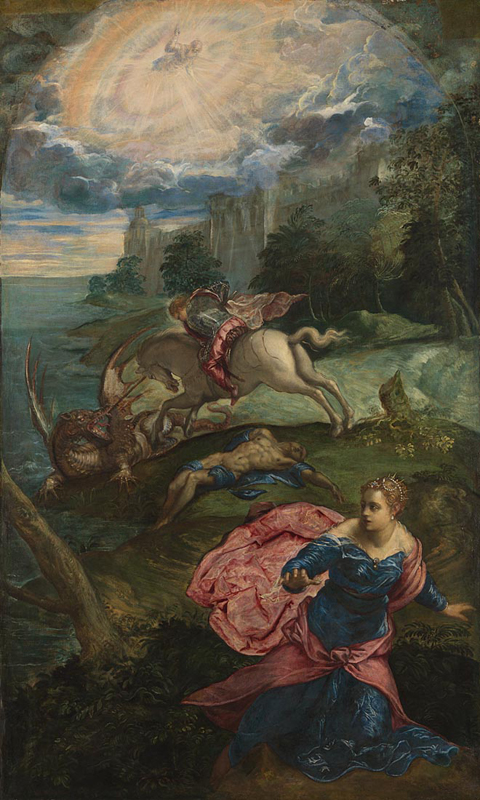
Saint George and the Dragon was painted by Jacopo Tintoretto in the mid-sixteenth century and is now in the National Gallery London. The subject comes from a popular Christian legend in which Saint George rescues a princess from a dragon that has been terrorising a city. Tintoretto presents the story as a dramatic clash between chaos and courage, set within a vivid natural landscape.
According to the legend, the dragon demanded regular human sacrifices. When the king’s daughter was chosen, she was left by a lake as an offering. At that moment, George, a Christian knight, arrived and confronted the beast. In Tintoretto’s painting, the action is already underway. The dragon lies partially subdued, twisted on the ground as George charges forward on horseback. His lance pierces the creature, symbolising the triumph of faith over evil.
In the foreground, the princess turns in alarm. Her flowing garments and startled expression heighten the tension. She appears caught between fear and hope, representing both vulnerability and deliverance. A lifeless body nearby reminds viewers of the dragon’s earlier victims, grounding the myth in visible consequence.
Above, the sky opens dramatically. Light breaks through the clouds, and an angel appears, suggesting divine support for George’s mission. The landscape itself feels turbulent, with twisting trees and shifting light reinforcing the instability of the moment. Tintoretto uses movement rather than stillness; the composition is dynamic, almost cinematic.
The dragon functions as more than a literal monster. In Christian symbolism, dragons often represent sin, paganism, or chaos. George’s victory therefore becomes spiritual as well as physical. The story gained popularity during the Middle Ages and Renaissance as an example of steadfast faith confronting danger.
For modern viewers, Saint George and the Dragon remains compelling because it captures the instant of decisive action. The painting does not dwell on aftermath or celebration but on risk and confrontation. It presents courage not as calm heroism but as a sudden intervention in crisis. Tintoretto transforms a familiar legend into a vivid meditation on fear, faith, and the human desire for protection against forces that seem overwhelming.
Weblink: https://www.nationalgallery.org.uk/