
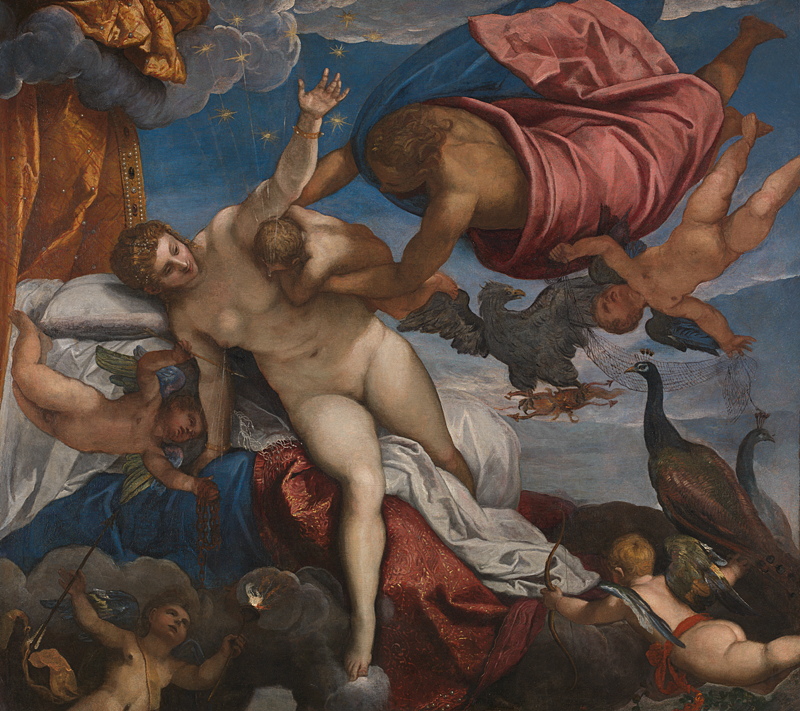
The Origin of the Milky Way was painted by Jacopo Tintoretto around 1575 and is now housed in the National Gallery, London. The subject comes from classical mythology and illustrates a dramatic moment involving the goddess Juno (Hera in Greek mythology), the god Jupiter (Zeus), and the infant Hercules. Like many mythological paintings of the Renaissance, it combines spectacle with storytelling.
According to the myth, Hercules was the illegitimate son of Jupiter and a mortal woman, Alcmene. Jupiter wanted his son to become immortal, so he placed the baby at Juno’s breast while she slept, hoping he would drink her divine milk. When Juno awoke and realised she was nursing her husband’s child by another woman, she pushed him away in anger. In that sudden movement, her milk sprayed across the heavens, forming the Milky Way. Drops that fell to earth were said to create white lilies. The painting captures this explosive, theatrical instant.
Juno is shown recoiling, her body twisting away in shock and indignation. Hercules, far from appearing helpless, grips her with surprising strength, foreshadowing the heroic power he would later display in his Twelve Labours. Jupiter appears nearby, orchestrating the scene, a reminder of his role as both king of the gods and habitual deceiver. The composition emphasises tension: divine authority, jealousy, ambition, and fate all collide in one suspended moment.
Beyond the myth, the painting reflects Renaissance fascination with the cosmos. The Milky Way was not yet understood scientifically; it was still open to poetic explanation. By visualising its origin as an act of divine drama, the painting links human emotion—anger, pride, maternal instinct—to the structure of the universe itself. The heavens become an extension of personal conflict.
For modern viewers, the story may seem fantastical, yet it highlights enduring themes: parental rivalry, the desire for legacy, and the lengths people will go to secure immortality. In Tintoretto’s interpretation, the night sky is not cold and distant but born from passion and conflict. The universe, in this myth, begins with a family dispute—an idea both humorous and strangely human.
Weblink: https://www.nationalgallery.org.uk/