
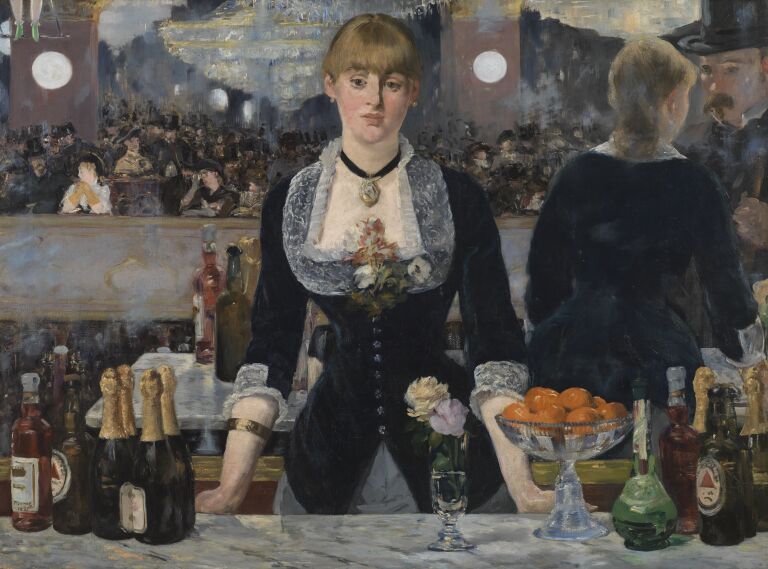
Displayed in the Courtauld Gallery in London, A Bar at the Folies-Bergère is one of the best-known paintings of the French artist Édouard Manet and one of the defining works of late 19th-century modern art. Painted in 1882 near the end of Manet’s life, the artwork captures the atmosphere of the Folies-Bergère, one of Paris’s most famous entertainment venues during the Belle Époque period.
At the centre of the painting stands a barmaid named Suzon, positioned behind a marble counter filled with bottles, flowers and fruit. Behind her, a large mirror reflects the crowded music hall with its chandeliers, performers and customers. At first glance the scene appears straightforward, but the reflection creates a visual puzzle that has fascinated viewers for generations. The angle of the mirror seems slightly impossible, making the relationship between the barmaid and the male customer difficult to interpret fully.
This ambiguity is one reason the painting became so influential. Rather than presenting a simple narrative, Manet created a scene filled with uncertainty and psychological distance. Although surrounded by noise and entertainment, the barmaid appears detached and isolated. Her expression feels thoughtful and emotionally distant despite the lively setting around her.
The Folies-Bergère itself symbolised modern Parisian nightlife during the late 19th century, attracting wealthy visitors, artists and tourists. Yet behind the glamour, the venue also reflected changing social realities, including class divisions and the complicated role of women working within urban entertainment culture. Some historians interpret the painting as quietly exploring loneliness and commercialisation in modern city life.
Manet’s style also marked a turning point in art history. Although associated with Impressionism, he retained stronger outlines and darker tones than many Impressionist painters. His loose brushwork, modern subject matter and unconventional composition challenged traditional academic painting and influenced later artists including Degas and the Post-Impressionists.
When the painting was first exhibited, audiences were intrigued by both the technical complexity of the mirror reflection and the unusual emotional atmosphere. Even today, viewers continue debating exactly what the reflection means and whether Manet intentionally distorted perspective.
For visitors exploring the Courtauld Gallery in London, A Bar at the Folies-Bergère offers more than a snapshot of Parisian nightlife. The painting captures the excitement, isolation and complexity of modern urban life in a way that still feels remarkably contemporary more than a century later.
Weblink: https://gallerycollections.courtauld.ac.uk/object-p-1934-sc-234