
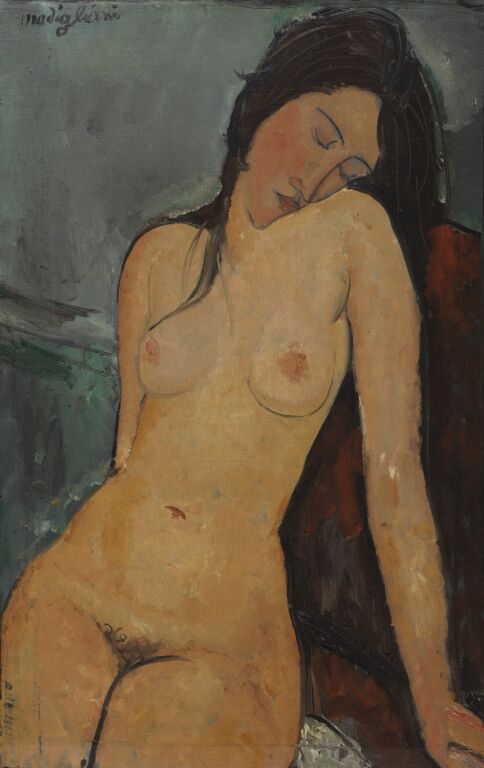
Displayed in the Courtauld Gallery in London, Nude by Amedeo Modigliani is one of the gallery’s most celebrated modern paintings. Created in 1916 during the height of the artist’s short career in Paris, the work reflects the distinctive style that made Modigliani one of the most recognizable figures of early 20th-century art. With its elongated forms, simplified features and quiet sensuality, the painting stands apart from more traditional European depictions of the nude.
The painting shows a reclining female figure lying across the canvas with direct and unapologetic presence. Unlike the highly idealised mythological nudes of the Renaissance, Modigliani’s figure feels modern, intimate and human. The warm skin tones, curved lines and calm expression create a sense of stillness rather than dramatic emotion. At the same time, the elongated proportions give the body an almost sculptural elegance that became one of Modigliani’s trademarks.
When Modigliani first exhibited his nude paintings in Paris in 1917, they caused considerable controversy. Police reportedly closed the exhibition on its opening day after complaints that the paintings were indecent. Although nude subjects had existed in European art for centuries, Modigliani’s direct realism and visible body hair shocked some viewers because the figures appeared less mythological and more like real women.
Modigliani himself lived a turbulent and often tragic life. Born in Italy, he moved to Paris and became part of the city’s bohemian artistic community, where he struggled with poverty, illness and addiction. He died from tuberculosis at only thirty-five years old, long before his work achieved worldwide recognition. Today his paintings are among the most valuable and recognizable works of modern art.
The influence of African sculpture, Renaissance portraiture and modern European painting can all be seen in Modigliani’s style. Rather than focusing on realistic anatomy, he simplified forms into flowing lines and smooth surfaces that emphasised mood and elegance over detail.
Many people consider Nude a masterpiece because it helped redefine how the human body could be represented in modern art. The painting balances sensuality with restraint, intimacy with abstraction and simplicity with emotional depth.
For visitors exploring the Courtauld Gallery in London, Nude offers a striking contrast to earlier religious and historical paintings nearby. It reflects the moment European art moved toward a more personal, modern and psychologically complex vision of beauty.
Weblink: https://gallerycollections.courtauld.ac.uk/object-p-1932-sc-271