
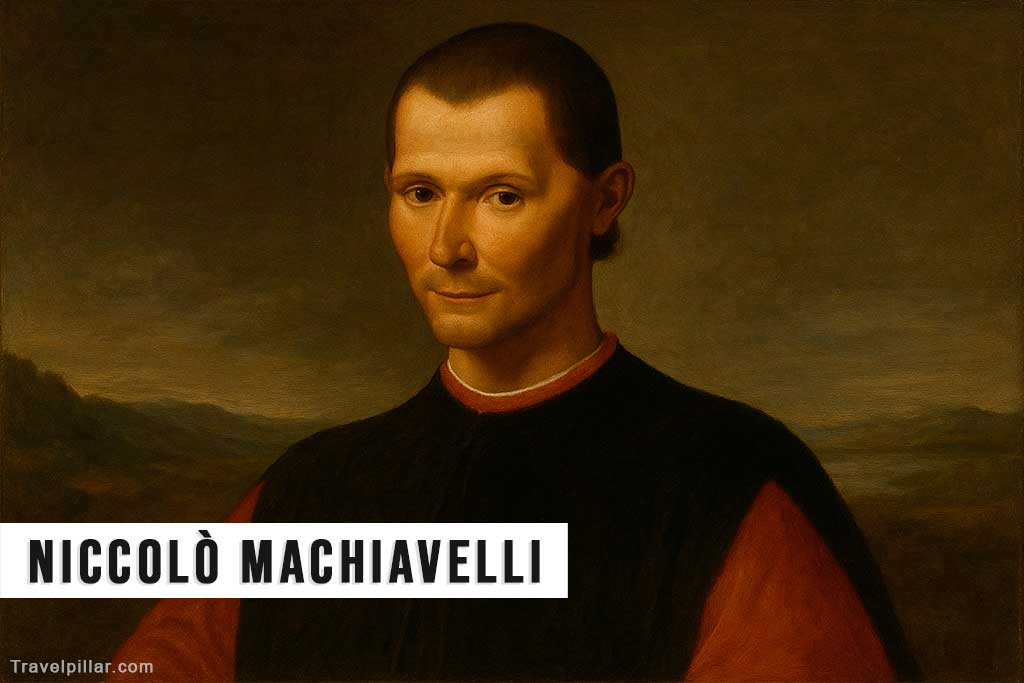
Niccolò Machiavelli (1469-1527) is one of the most prominent figures in the development of political theory. He was born in Florence, Italy, during the time of the Italian Renaissance, a period of significant intellectual growth and cultural change. His life was largely shaped by the turbulent politics of his city-state, which fluctuated between republican and Medici rule.
Machiavelli started his career as a civil servant in the Florentine Republic, ascending to the role of the Second Chancellor. During his tenure, he performed a variety of duties, including diplomatic missions to foreign courts and military roles during wartime. However, his career came to an abrupt halt when the Medici family regained control in 1512, resulting in Machiavelli’s dismissal and subsequent imprisonment.
After his release, Machiavelli retired from public life and turned to writing. His most renowned work, “The Prince” (1532, posthumously), marked a significant shift from traditional, moralistic views of political theory. Instead, Machiavelli proposed a pragmatic approach, often perceived as ruthless or immoral, advising rulers to prioritize power and self-interest over ethical concerns. This perspective established Machiavelli as a father of modern political science and gave rise to the term ‘Machiavellian,’ often used to describe manipulative political behavior.
Besides “The Prince,” Machiavelli authored several other notable works, including “Discourses on Livy” (1531), a treatise on republicanism and historical analysis, and “The Art of War” (1521), a military treatise. In addition, he wrote numerous plays and histories that contributed significantly to Italian literature.
Despite being a controversial figure, Machiavelli’s influence on political philosophy is undeniable. His practical and often cynical examination of politics has not only shaped the field of political science but also profoundly impacted societal understanding of power dynamics.